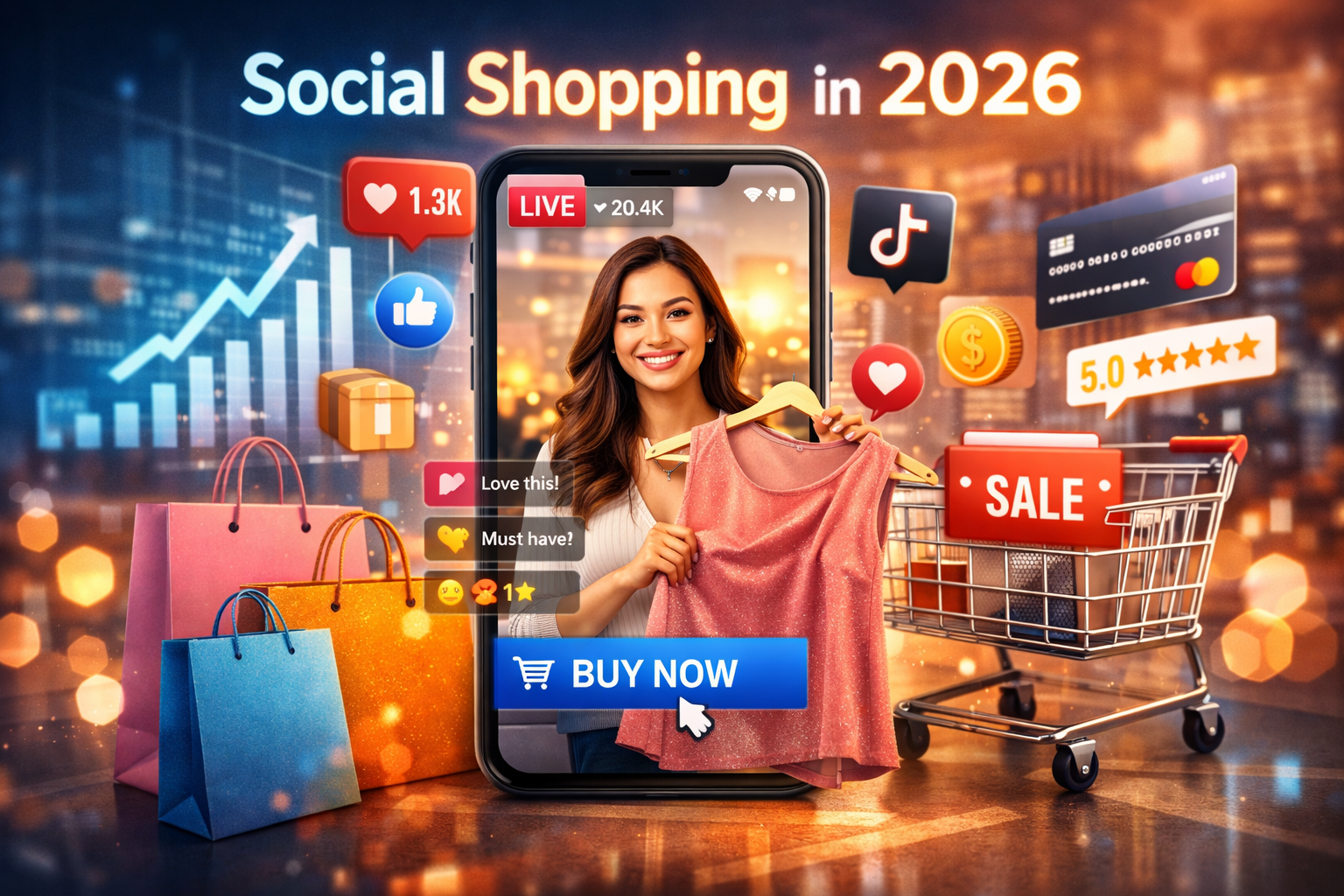
A few years ago, the term social shopping was a buzzword that implied a shortcut. A person saw a nice video, clicked a link, went to a website, and decided they’d buy it later… which they didn’t. Fast forward to 2026, and the space between desire and acquisition is shrinking to mere seconds. The feed isn’t just where social commerce discovery happens; it’s where the transaction actually takes place.
This phenomenon is also reflected in the statistics. According to EMARKETER, social commerce sales in the US are set to reach $100 billion in 2026, a psychological barrier that signifies social shopping is no longer a secondary channel but part of the larger narrative.
But the interesting question isn’t whether social shopping is increasing in popularity. Rather, the interesting question is what makes 2026 a defining moment in space and what you must do to remain competitive before the space becomes even more crowded, expensive, and competitive.
The moment the browse turned into the buy
Social media has always been good at the ‘desire’ business. It has been designed to keep you engaged, interested, and even obsessed. However, social media has never been designed to enable purchases until now.
Social shopping in 2026 is exploding because it has become seamless enough to feel native. A person doesn’t want to leave the app, click another tab, sign in, search for the shipping details, and then buy the product. A person wants the same experience they get from consuming content.
This is why TikTok is a big part of the conversation. According to the EMARKETER forecast in January 2026, more than half of US social buyers (51%) plan to shop on TikTok this year. That’s an awful lot of intent concentrated on a single platform. And TikTok Shop is not just “hot.” TikTok Shop is driving real transactional volume. According to a report cited by DealStreetAsia, TikTok Shop drove $15.1 billion in US GMV in 2025, up 68% YoY. Global GMV nearly doubled to $64.3 billion in 2025.
Translation: the platform is driving more than just influence. The platform is driving real receipts.
Why 2026 is different from the social commerce hype cycles
Social shopping has had several hype cycles: buy buttons, storefront tabs, influencer promo codes, and affiliate links. Most of these were effective, but they didn’t change the way people behaved. 2026 is a different year because several things are happening at the same time.
Video has become the storefront. Short-form video isn’t just a way to entertain; it’s also a product demo, a review, a tutorial, and a before/after all in one. And the content sells without ever feeling like a sales pitch, particularly if the content creator is the face behind the product.
Recommendation engines have become shopping engines. TikTok has never said, “Hey, join us. Follow your friends.” Their pitch has always been, “We’ll find what you like.” And that model is particularly well-suited to commerce because the best ad for a product isn’t actually an ad, it’s something the shopping engine has determined you’d love.
Payments have gotten easier and more local. Instant payment systems and mobile-first checkout options around the globe are bringing more people into the digital economy. A good example of this is Brazil, where Reuters reported that Pix has become a dominant form of online payment and is expected to continue to increase in usage, indicating the pace at which consumers will adopt payment systems once they feel comfortable using them. When the payment system is effortless, social platforms are even more powerful because they already own the attention of the consumer.
And then, of course, there’s the influence of AI, which is driving consumers from consideration to action. A Reuters report based on data from Salesforce found that in the 2024 holiday season, $229B in sales were driven by AI, in addition to increasing chatbot usage to help consumers make decisions and buy products. The key point here is that in 2026, the question of whether or not to buy something is being answered inside the experience, not after the experience.
Livestream shopping is no gimmick
There’s a reason why livestream shopping continues to be part of the conversation: it works.
When you see someone use a product, answer questions, compare products, and overcome objections in real-time, it’s like the real shopping experience, minus the trip to the mall, and the “add to cart” button is right in front of you.
This is exactly what McKinsey predicted years ago: live-commerce-driven sales could reach 10%-20% of the entire e-commerce space by 2026, depending on the trajectory of the Chinese market and the live-commerce model. Whether or not all markets will reach the higher end of this range remains to be seen, but the point is clear: the mix of entertainment + instant purchase is no longer a trend; it’s a new state of default for some categories.
The trust factor: why people buy faster on social than brands expect
There’s a quiet psychological shift happening. Social shopping feels less like “I’m being marketed to” and more like “I’m being shown proof.”
Proof can be the creator’s authority, comments from people who have the same product, duets/stitches responding to a brand claim, or even just the fact that thousands of people saw the same product and didn’t swipe away. Social media makes products into conversations, and conversations eliminate uncertainty.
Deloitte’s 2025 press release on digital media trends highlighted that “social platforms play an important role in influencing buying decisions, with Gen Z (63 percent) and millennials (49 percent) rating ads or product reviews on social media as most influential in their purchasing decisions.”
The Bottom Line: Social Shopping Becomes Retail’s Front Door
Social shopping is booming in 2026 because the most powerful engine on the internet today, attention, has merged with the easiest thing in the world for businesses to offer: instant purchase.
For brands, this means both an opportunity and a threat, and the threat is less visible: Social platforms are no longer just ad platforms; they’re now also platforms. And platforms are built for speed, trust, and execution.
To succeed in 2026, the brands that win won’t be the ones that “try social commerce.” They’ll be the ones that make it their business strategy, because that’s exactly what it has become.