Think of a playground where two sets of kids both love the same swing sets. It’s a recipe for a fight in seconds, so the teachers draw up special rules: who plays where, when, and how. Most of the time, these rules keep the peace.
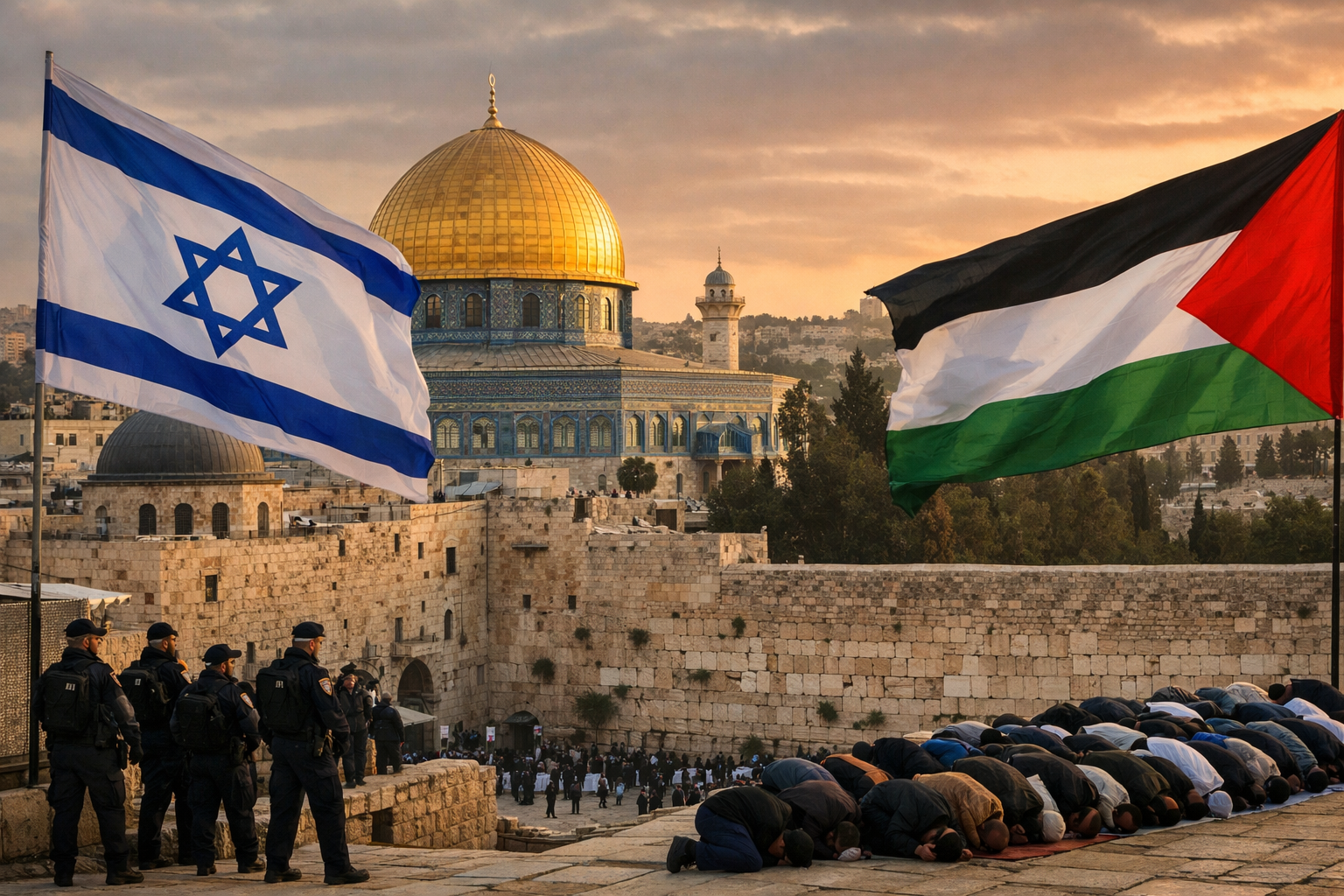
That’s what’s meant by “status quo” at the most contentious holy site in Jerusalem: the hilltop compound known as Haram al-Sharif to Muslims and the Temple Mount to Jews. And right now, these rules are up for debate again, and loudly so, because many people think these rules are being stretched, bent, or simply quietly changed during a time of already heightened emotions.
What does “status quo” mean here
“Status quo” is just a fancy way of saying: “Keep things the same as they are.” At this holy site, the “same as it is” principle usually means the treaty that emerged after 1967, when Israel captured East Jerusalem in the Six-Day War but left the day-to-day religious running of the site inside to a Jordanian-run Islamic trust.
The bottom-line understanding most people have in mind looks like this:
- Prayers continue as usual for Muslims at the site’s mosques and open areas.
- Non-Muslims (including Jews and visitors) can visit at designated times, but non-Muslim prayer has traditionally been banned.
- Security and policing around the entrances is up to Israeli authorities, while the site’s internal religious affairs are tied to the Jordanian-run Islamic Waqf.
This is also a matter of politics and international diplomacy. In the 1994 peace treaty between Israel and Jordan, Israel formally agreed to recognize Jordan’s “special role” in Muslim holy shrines in Jerusalem.
Why this particular spot is a “spark” that could set a fire
This particular spot is more than another religious site. It is home to some of the most powerful symbols of emotion in the world:
- For Muslims, it includes the Al-Aqsa Mosque, which is considered the third-holiest site in Islam, and the surrounding sanctuary.
- For Jews, it is the holiest site in Judaism, associated with the ancient temples.
- Right nearby is the Western Wall, where Jews pray publicly.
When people feel like the rules for one side are being changed, even a little, many people are afraid that it is only the beginning of losing control, losing access, or changing history. This can lead to a small problem becoming street protests, violence, and political crises.
Why is the “status quo” debate resurfacing right now?
There are three big reasons why this issue is now making headlines.
1) Ramadan means massive crowds and massive anxiety
During Ramadan, as many as hundreds of thousands of faithful may pass through the area to pray, especially on Fridays. This means that security is even tighter, with more checkpoints and more opportunities for disputes to arise. There has been recent reporting that Israeli authorities are preparing large numbers of police, while Palestinian officials claim that Israel is imposing restrictions on access to the compound.
2) Visiting hours are being changed
In the last few days, there have been reports of Israeli police extending or changing visiting hours for non-Muslims during Ramadan at the compound, which has been characterized as a “dangerous escalation” by Palestinian leaders and others, while some Temple Mount activists have characterized it as “no big deal.”
To someone who is not involved in the conflict, an “extra hour” may seem like a small thing. But to a place where time is part of the unspoken agreement, even small things can seem like someone is moving the goalposts.
3) The dispute over Jewish prayer is now more visible
Another hotspot: whether Jews are praying there, and how much.
There are reports that police have allowed more visible or more regular Jewish prayer than before, which is seen as a significant shift from the previous status quo.
On the other hand, Israeli authorities have again and again asserted that there has been no change in policy. Following a previous visit by far-right minister Itamar Ben-Gvir, who asserted that he prayed at the site, the office of Prime Minister Benjamin Netanyahu again asserted that “Israel’s policy of maintaining the status quo at the holy site has not changed.”
This combination of “nothing changed” and “something is changing” is exactly what causes the controversy to blow up again and again.
Who is in charge of what, and why does it never stay simple
When you ask, “Who is in charge of this place?” you get different answers depending on whom you ask.
Israel is in charge of the overall security and access, which it says is required to prevent violence.
The Waqf authorities, who are backed by Jordan, consider themselves to be the custodians of the site’s Islamic nature and its day-to-day religious administration, and they tend to see Israeli policing policies as an interference in their work.
The Palestinian side tends to see any increase in non-Muslim access or prayer as an attack on the site’s Islamic nature.
The international community tends to call for maintaining the status quo, saying that any changes could ignite the whole region. The United Nations Security Council has heard warnings again and again that the status quo must be maintained.
And all of this is complicated by the ongoing conflict in the region since October 2023, which makes every symbol even more pointed. There are reports and analyses that connect fears about the site to broader mobilization and violence, including mentions of Hamas using Al-Aqsa-related rhetoric in the past.
What follows next: why “quiet weeks” matter more than big speeches
Usually, the status quo doesn’t shatter because of one big speech. It crumbles in small increments: a new route taken here, a new time slot introduced there, a new way of enforcing rules, an inflammatory visit, a viral video.
This is why this debate is relevant once again. Ramadan is upon us, rules are being tweaked, and both sides are looking for signs that “normal” is being rewritten.
If leaders seek calm, it is the “boring” stuff that matters most: predictable rules of access, communication, prudence at critical moments, and avoiding behavior that resembles victory dances in a shared (and disputed) space of millions of souls.
Because at this particular hilltop in Jerusalem, a small step may feel like a giant step in the wrong direction. And when people feel as if they are losing something holy, they do not respond quietly.