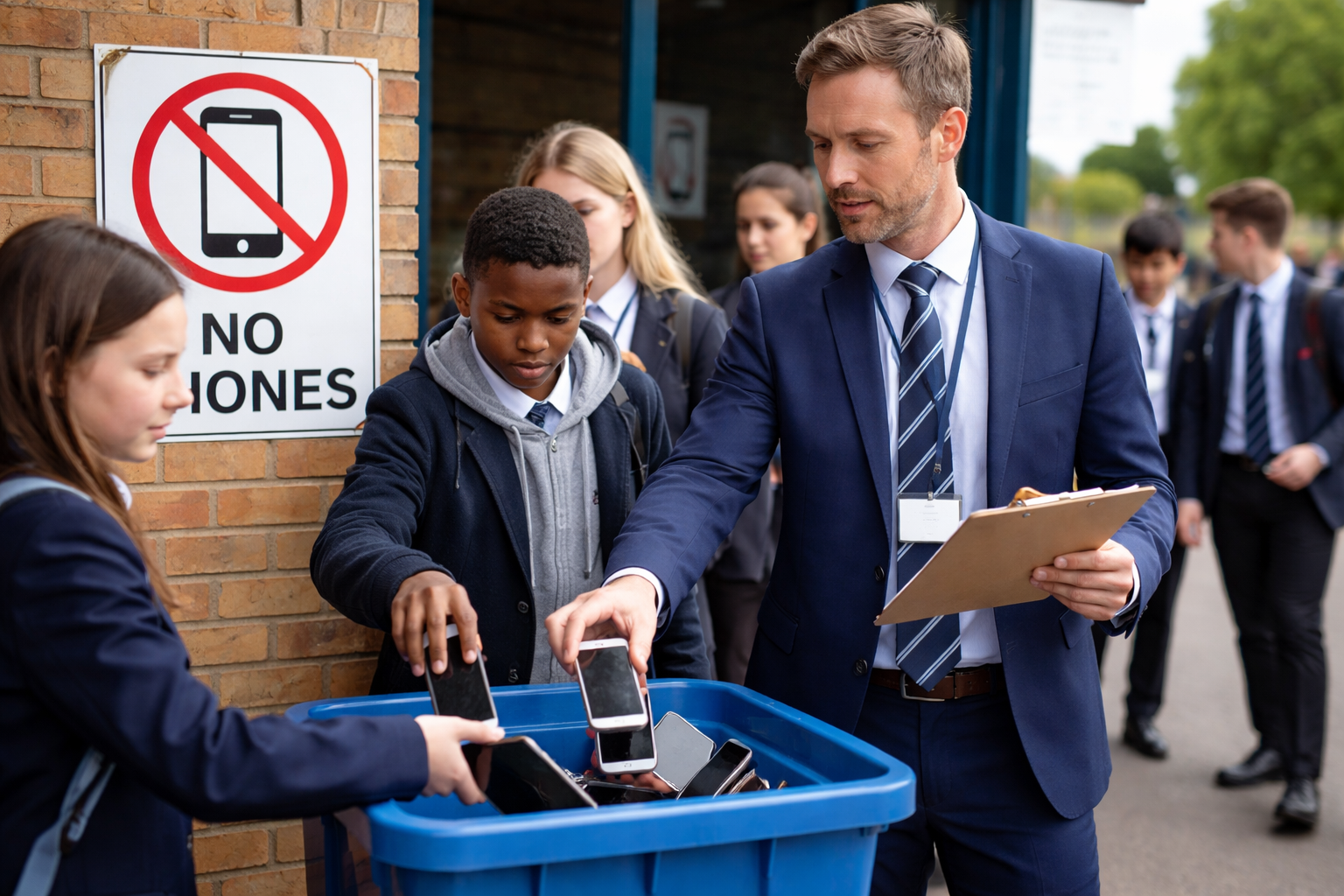
At 8:25 a.m., the school gates open, and the process begins. Teachers stand by a crate as students arrive with their phones in hand. “We promise we won’t use them!” The teachers take the phones anyway. Some students claim it’s needed on the bus, at home with Mom, or for a medical appointment. Others try to sneak past with a second phone. By the first period, it all looks good on paper. The reality? Constant negotiating.
The debate has resurfaced due to an update to the Department of Education’s advice to schools in England in late January 2026. The Department of Education urged school leaders to “make today phone-free by default.” New research has also shed light on just how much work goes into enforcing it: over 100 staff hours a week, no matter what method. The policy seems simple. The execution is draining.
Why the phone policy won’t go away
It’s no longer just a phone. It’s a camera, social media, group messages, games, and an endless stream of updates. In the classroom, it’s a distraction. In the halls, it’s recording fights or bullying. The “phone-free schools” concept also fits into a broader desire to better manage children’s relationship with phones and social media.
The government has connected it to “solving issues with social media.” Ofsted will also be expected to evaluate it.
The message to school leaders: it’s not just writing a policy. We want to see it work.
What the new guidance is actually asking for
The new guidance is still only guidance, not law, in England. The “crackdown” in February 2024 set the direction, which was strengthened in January 2026: “Schools should be phone-free all day unless there is a genuine reason why they should not be.”
In practice, school leaders are being asked to ensure pupils are not using phones not only in class time, but also between classes, at break, and at lunch. Teachers are also being asked to model the behavior they expect of pupils. According to a briefing by the House of Commons Library, most schools already have phone bans, but the new guidance is more specific about the direction to go: “phone-free unless there is a good reason to the contrary.”
However, the guidance still leaves the difficult decisions to the school. How do you manage phones at the gate? Do you make them take off in bags, use lockers, or provide lockable pouches? What do you do if you see a phone? What are the consequences? Each of these models has its own complexities.
“It’s a huge drain”: what enforcement means in practice
The University of Birmingham conducted research to quantify the problem, which was published in BMJ Mental Health. The study examined 20 secondary schools and found that each school spent over 100 staff hours per week enforcing its phone policy.
Both “restrictive” and “permissive” schools spent significant time and energy managing phone policies, with the study concluding that there was only a small financial penalty to “permissive” schools, £94 per pupil.
The enforcement of phone policies is not just about telling off the odd pupil; it’s about creating a system of storage, recording, tracking, and dealing with repeat offenders, managing parent complaints, and the pupil who refuses to give up their phone because of what’s on it.
This doesn’t, of course, mean that phone-free schools are impossible, merely that they are expensive, and “just enforce it” is an easy phrase to throw about without thinking about what’s actually involved.
Why unions are pushing for support
Where rules are different, conflict is inevitable, with parents often comparing policies, children disagreeing over what is fair, and teachers being drawn into micro-conflicts that eat away at authority.
Teaching unions are now stating plainly that “this isn’t something we can solve individually as schools.” NASUWT has urged legislative controls to be put in place and has supported measures such as secure storage via lockable pouches. The union’s message also extends to safety issues. The fewer phones in circulation, the fewer instances of covert recording and internet bullying during the school day.
Does banning phones actually work?
Research suggests mixed results. There are many reports of immediate benefits to school life. There are also concerns about issues such as attainment and bullying due to mobile phone usage.
Yet the evidence remains cautious when making broader claims. Research from the University of Birmingham found that restrictive school policies may not necessarily reduce the use of phones and social media as a whole. The UK’s SCAMP study, featured in The Lancet Regional Health, Europe, found that even when school policies are more restrictive, there may not be significant changes to broader outcomes.
Thus, school bans may improve the school day but not necessarily the broader digital world that follows the child home from school.
What happens next
For now, England is in a guidance phase, with stronger expectations and increased inspection attention, but no single law that can provide a solution to enforcement issues. There is still much pressure on schools to adopt a more uniform approach, with parliamentarians proposing various amendments to strengthen restrictions, while arguing over exemptions and unintended consequences.
Alongside guidance, there is also support from the Attendance and Behaviour Hub, which includes schools that have already implemented phone-free policies, providing practical help to schools that wish to adopt this new approach.
If ministers are to deliver on their promise of making phone-free schools the new normal, they may have to offer more than guidance, including funding for storage, staff protections, and exemption structures that can actually work in practice. Until then, teachers continue to cope with a modern problem with few resources at their disposal, trying to teach in the middle of it all.
Students, meanwhile, continue to test the limits, because that is what teenagers tend to do, especially online every day of the week.
Curious what else is happening in the world?Click here to explore more interesting stories.