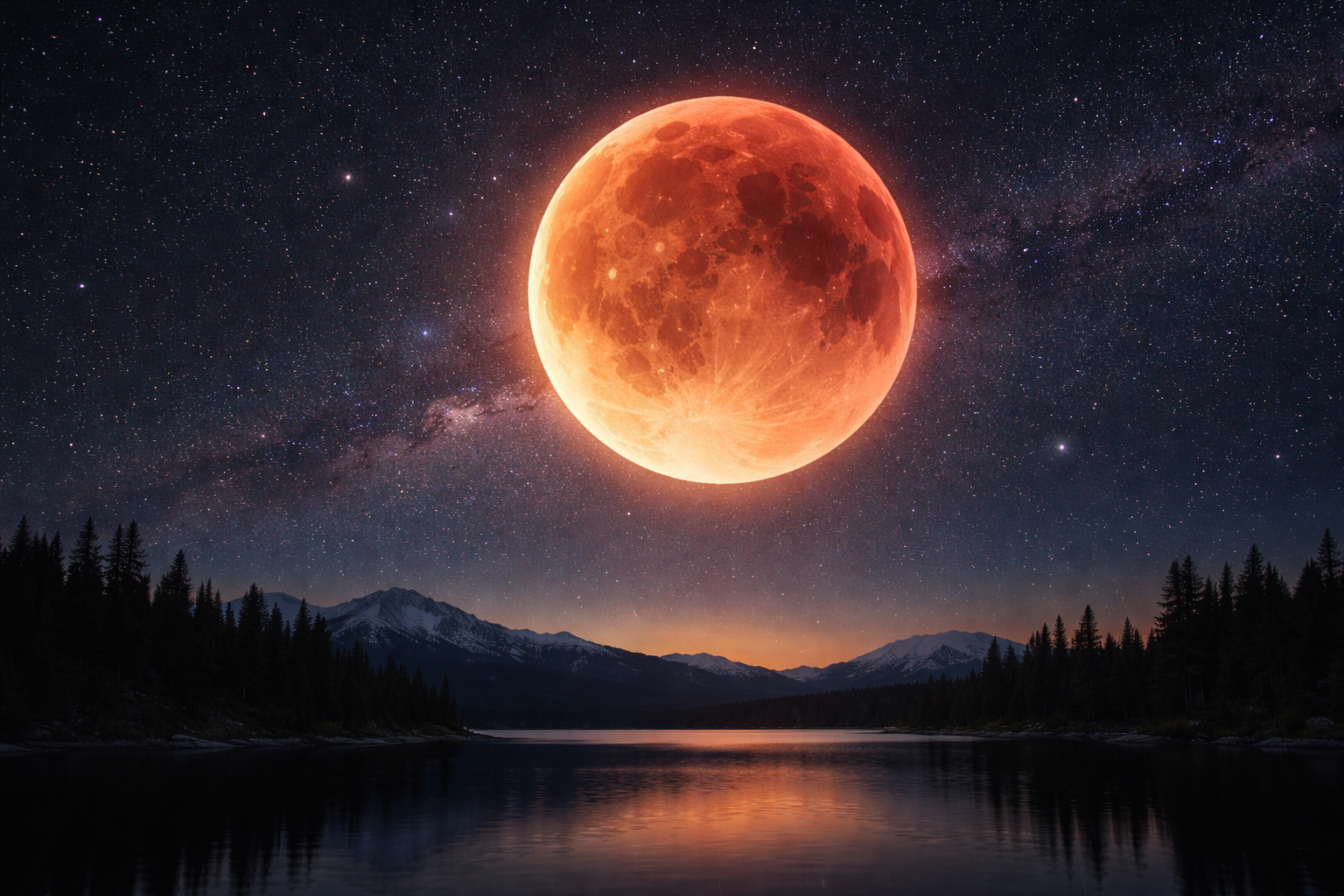
You are outside on a typical night. The full Moon appears bright enough to cast a shadow. Then, gradually, it becomes less bright. Not like when you flip a switch, and the lights go off, more like someone turning the brightness knob on a TV gradually.
A dark shadow appears on the Moon. For one hour, the Moon appears coppery-red as if it borrowed color from a sunset. This is called a total lunar eclipse. The next total lunar eclipse occurs on March 2-3, 2026.
What a total lunar eclipse is (simple explanation)
A lunar eclipse occurs when Earth moves between the Sun and the Moon during a full Moon. The Moon moves into Earth’s shadow, so less sunlight reaches it.
Earth casts two shadows:
- Penumbral shadow: the outer, light shadow where the Moon appears less bright.
- Umbral shadow: the inner dark shadow where the Moon appears to have a “bite.”
When the moon is totally under the umbral shadow, that’s the exact moment people long for.
Why does the Moon look reddish during a total lunar eclipse?
The Moon does not disappear during a total lunar eclipse. It actually appears to be painted red because the Earth scatters sunlight. Blue light scatters more easily, while red/orange light travels through. In other words, the Moon appears to be illuminated by “all the sunsets and sunrises on Earth at once.”
The Moon does not always look like this. Sometimes it appears bright orange. Sometimes it appears deep brick red. Tiny changes in the Earth’s atmosphere cause this.
Where the March 3, 2026 eclipse will be visible
The simplest piece of advice is this: “If it is nighttime in your location and the Moon is above your horizon, you can see this eclipse.”
For this eclipse, NASA says:
- Eastern Asia and Australia: evening,
- Pacific Ocean: night,
- North and Central America: early morning,
- and far western South America: early morning.
It will be a partial eclipse in parts of central Asia and much of South America, but won’t be visible at all from Europe and Africa.
If you want a very simple “yes or no, visible in my city,” then you can use the interactive map on Time and Date, where you can type in your city to see whether or not it will be visible there.
NASA has a special visibility map graphic for March 3, 2026.
The key times (use UTC, then convert locally)
These are the main phases (from NASA’s eclipse guide):
- Penumbral eclipse begins: 08:44 UTC
- Partial eclipse begins: 09:50 UTC
- Totality begins: 11:04 UTC
- Totality ends: 12:03 UTC
- Partial eclipse ends: 13:17 UTC
- Penumbral eclipse ends: 14:23 UTC
Totality will last about 58 minutes: Long enough that you don’t have to be perfect with timing, but short enough that you’ll want to plan.
How to watch (the best part: it’s easy)
You don’t need anything fancy. A lunar eclipse is safe to watch with your naked eye. No special eclipse glasses are needed (those are for solar eclipses only).
To make the experience better:
Find a spot with a good view of the sky and minimal bright lights. Bring a jacket, a hot drink, and be prepared to wait: this will be a slow but wonderful experience.
Using binoculars will sharpen the edge of the Earth’s shadow, and a small telescope will bring out details while in totality, as the moon will be dark.
What you’ll actually see, step by step
You might wonder if anything is happening in the beginning. The penumbral eclipse might look like the Moon is simply less bright than it was before. Then the partial eclipse will start, and it will be unmistakable: a dark shape will slowly grow across the face of the Moon as if someone is shading it with a piece of charcoal.
During the total eclipse, the Moon will be completely in the Earth’s umbra. That’s when the color change will occur, often the time when people say the Moon looked ‘unreal.’ Then the shadow will move away from the Moon, and it will slowly revert to its normal bright look of a full Moon.
Simple photo tips that actually work
If you are using a phone to capture images, the most important thing to remember is to make sure it is stable. If you lean it up against something or use a tripod, you will be able to get better photos. The Moon will be less bright than it normally is during a total eclipse, so photos will look grainy if your phone is not good at handling that light.
If you’re using a camera, a tripod will be helpful during the eclipse, especially since the Moon will darken and turn red during totality.
A fun idea: take one photo every 10-15 minutes from the time the eclipse starts to be partial, through to the time it becomes total, and then again as the eclipse ends. You will have the entire ‘story’ of the shadow of the Earth moving across the Moon.
If the weather doesn’t cooperate, there are other things to do
Clouds are the one thing that no one can schedule, and if your skies are cloudy, there’s nothing to do but try to find a clearer horizon, or just check out a livestream of the eclipse. Timeanddate usually has eclipse coverage and also allows their readers to see the eclipse preview from their city.
The Bottom LIne
Regardless, this eclipse is a rare and easy event to see: no special equipment required, no need to have a plan, and no need to know anything about the stars and planets to understand the event. Just step outside at the right time and look up, because for one night, you’re getting to see the shadow of the Earth on the Moon.