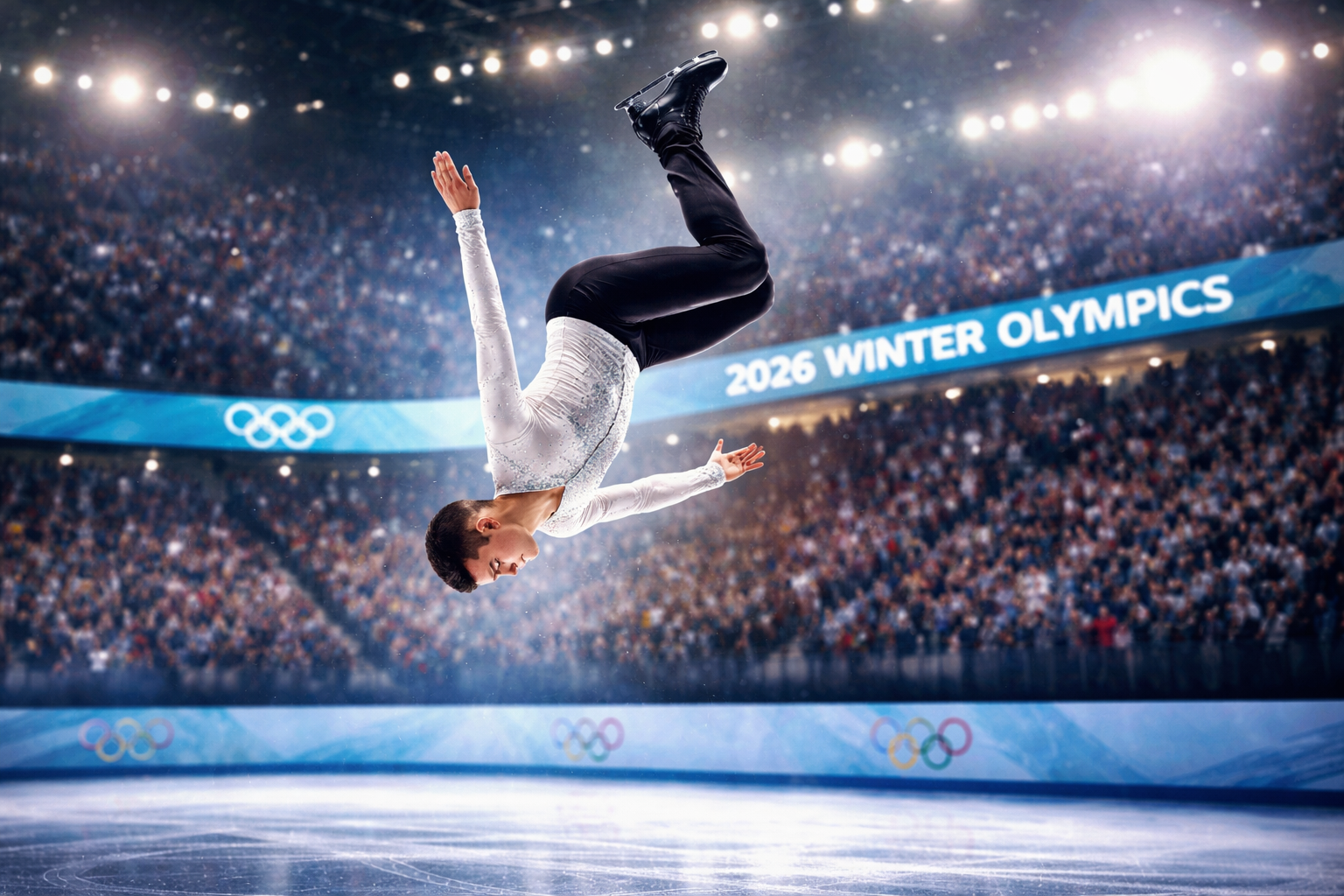
In a sport that requires precision, a backflip is absolute chaos, one moment of time where the skater literally disappears, suspended in mid-air, with all onlookers holding their collective breaths. And so, when Ilia Malinin performed one on the ice at the 2026 Winter Olympics in Milan, the response was instant: noise, replay requests, and then, of course, the bigger question: debate, in the stands, on social media.
Is it an iconic innovation, the kind of move that will ensure figure skating continues to remain relevant? Or is it just another dangerous trend, one that will continue to increase the number of injuries the sport does not need?
The history of the backflip in figure skating
The debate may be new, but the move certainly is not. In fact, backflips have been on figure skaters’ lists of banned moves, specifically as an “illegal somersault-type jump,” for decades. But all of that changed in June 2024, when the International Skating Union approved new rule changes that took the somersault jump off the list of illegal moves, meaning skaters will no longer be penalized for them, effective with the 2024-25 season.
The ISU was not going crazy, introducing big air to figure skating. The difference lies in the way it is scored. The backflip may be legal, but it is not given any real point value. In other words, it can be included in the choreography, which is judged on overall quality, not on any specific point value given to the flip.
The argument for progress
The first argument in support of the backflip is that it addresses a genuine issue: attention. Figure skating’s biggest audience comes out every four years. Between those Olympics, it competes with other sports offering immediate thrills in 10-second videos. The backflip is one of those videos. Recent coverage of the backflip during Malinin’s Olympic moment has discussed how the backflip is the move that gets even non-fans to sit up, react, and share.
Secondly, the backflip carries history. Surya Bonaly made the backflip well-known as her signature move when it was still banned. Many fans have always believed that the rules were as much tradition as they were safety. It now appears as acknowledging that spectacle need not come at the expense of ‘ruining’ artistry.
Another reason the decision to permit the backflip seems like an inevitable one is that the backflip has already come to be seen as a symbol by figure skaters. Indeed, Adam Siao Him Fa has said that the backflip represents ‘positive rebellion’ and that it may even come to be seen as a sign of freedom and individuality without replacing the jump elements that will still determine the outcome of competitions.
Another argument that has been put forward in support of the backflip, and that makes its inclusion appear inevitable, is the athletic argument. Indeed, it has been said that elite figure skaters are already pushing their bodies to incredible limits.
Indeed, quads are landed fast and with small margins of error. Pro-backflip advocates argue that the backflip may be controlled and that the sport does not have to worry about its inclusion because it does not score highly anyway.
The argument against the backflip
The argument against the backflip does not have to deny that the very top figure skaters may be able to do the backflip. Rather, the argument centers on the ‘slippery slope’. Even if the backflip does not score highly in its own right, the decision to permit it will still have an impact on the sport. Indeed, even if the decision to permit the backflip does not force ‘everyone to backflip to win,’ it may still force ‘everyone to feel like they need one to matter.’
That’s important because the backflip has a nasty failure mechanism: if the flip comes short of rotation, the result isn’t just a hard landing, it’s an inverted crash. When the sport’s young stars are looking at Olympic routines as instructional videos, the backflip that looks cool in a highlight reel can look disastrous in real life.
Figure skating is a sport that already has a significant injury burden. Research on injuries in the sport of figure skating reveals that there are overuse injuries, such as stress fractures, that are just as common as acute injuries. Surveys of injuries among competitive figure skaters also revealed that concussions are among the injuries that skaters sustain from the sport.
Add one more factor that increases the probability of head and neck impact, and coaches feel like they’re being asked to gamble for applause.
The Olympic environment doesn’t help. Injury surveillance and analysis have consistently shown that sports that emphasize aerial tricks also have among the highest injury rates at the Winter Games, including freestyle events like big air and halfpipe. Figure skating has never sought to be that kind of risk economy, and there are concerns that the backflip is merely the beginning of it.
Where the debate is likely headed after Milan
The most interesting aspect of the backflip debate is that the rule book is already trying to split the difference between those who want to see it in figure skating and those who want to see it eliminated. In making somersault-type jumps legal but not making it a points-heavy aspect, the ISU is making the backflip an optional flourish that can be exciting without changing medal math outcomes.
That may be true if the element remains rare, well-trained, and clean. But the Olympics are good at turning “optional” into “expected”, especially when something is repeated a thousand times.
If the following seasons demonstrate the new element’s safe, consistent use, the debate will turn to defining how the new movement is evaluated: whether or not it’s given explicit value, what sections of the program it’s allowed in, or whether its use is limited by level or age group. If an accident occurs, the discussion will focus on boundaries and safety.
The backflip currently occupies an interesting place: exciting enough to generate new “wow” moments without requiring athletes to put themselves in harm’s way to remain competitive.Curious what else is happening in the world? Click here to explore more interesting stories.