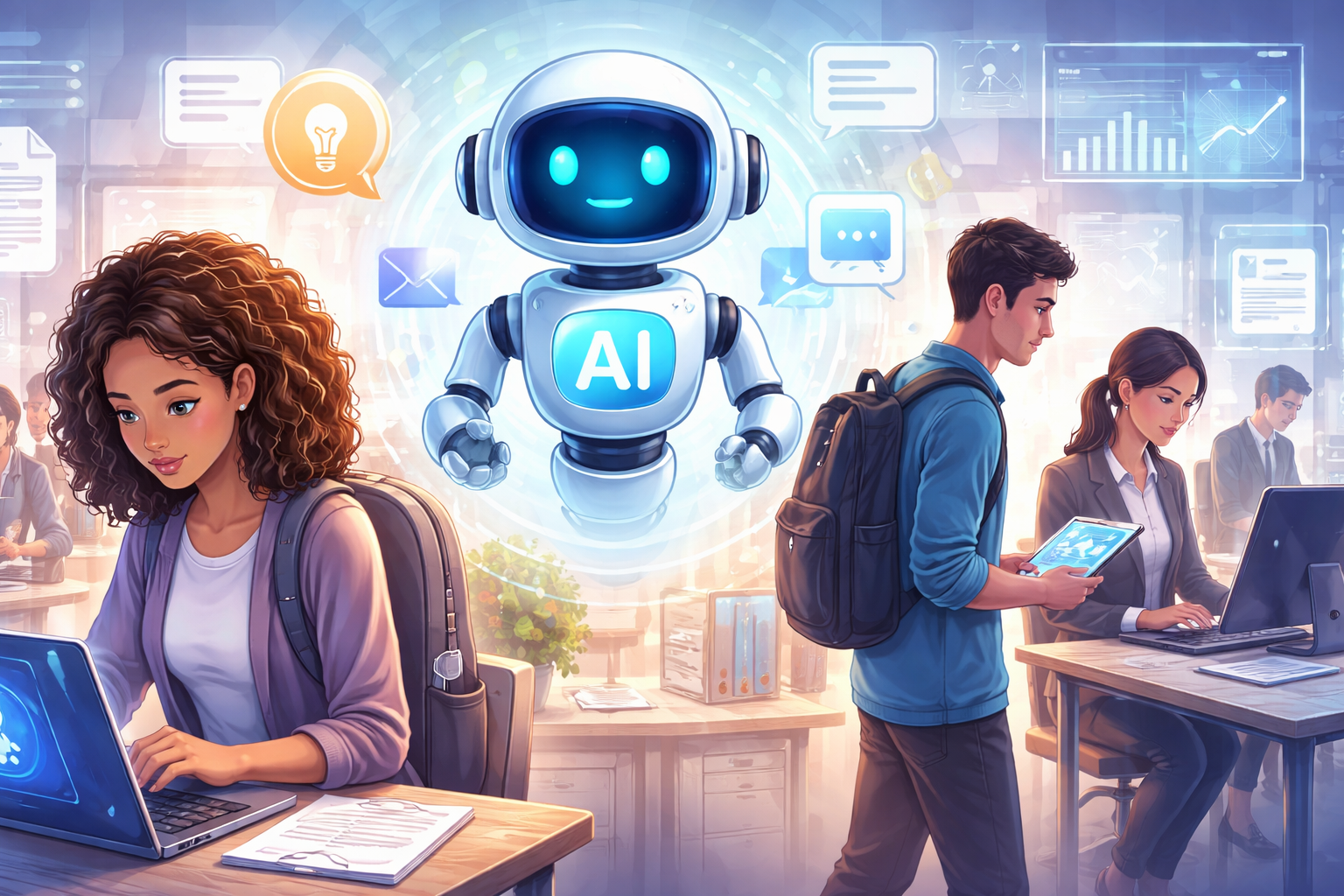
It’s a random weekday, and a student sits down in front of a computer, starts typing a question, and gets the answer in a matter of seconds. Meanwhile, a worker does the same before a crucial meeting, fine-tuning an email or breaking down a long report. AI for school and work is no longer a “future” concept; it’s a “now.” And that’s why people are debating loudly about one simple question: is AI helping us be more efficient and effective in our learning and productivity, or is it quietly making us weaker?
Well, the answer is complicated. AI can be a “word calculator”, good when used to help us learn, bad when used to avoid learning.
AI for school and work: a shortcut, a tutor, or a trap?
What is AI? AI can be a super-fast helper that never sleeps. Ask AI for some explanations, examples, or a simple plan, and it’s as if you have a patient tutor by your side. But ask AI to do your homework or write your report from scratch, and it’s a crutch, a helper that you rely on to the point that your brain stops lifting.
This is reflected in actual figures. In the US, for example, 26% of teenagers said they used it for schoolwork, twice as many as in 2023. What’s more, teachers seem less than convinced. Pew also found that a quarter of K-12 public school teachers in the US say AI does more harm than good, with many being uncertain.
So why are we still using it? Because if used properly, the benefits of AI are obvious.
How AI can help: clearer thinking, quicker starts, fewer “blank page” moments
AI is very good at what we call “first steps.” These can include brainstorming ideas, explaining a difficult topic in simpler words, or organizing messy notes in a neat outline. This is important because most people aren’t stupid; most people just can’t get started.
What’s the biggest advantage of AI at work? Time. An analysis by the Federal Reserve Bank of St. Louis found that workers who used generative AI reported saving 5.4% of their work hours, or 2.2 hours per week for someone working 40 hours a week.
In some jobs, the benefits of AI can be greater. A well-known NBER working paper on a generative AI assistant used by thousands of customer support agents found that the average productivity gain was 15%. Gains were larger for less experienced workers. In other words, AI helps beginners succeed faster.
When AI Fails: Mistakes, Dependency, and “I Didn’t Really Learn It”
The problem is that AI can be very confident when it’s wrong. “If you’re a student who uses AI to copy answers without checking, you’ll actually learn the wrong answer. If you’re an employee who uses AI to copy and paste into a client email, you’ll actually be passing on wrong answers in a professional tone.
There’s another problem that’s a little harder to talk about: dependency. If a child never learns to write without the help of AI, they’ll never think they can write without the help of AI. If a worker never learns to think through a problem without AI, they’ll never think through a problem.
This is why schools and companies are rushing to change their rules. UNESCO’s global advice on the use of generative AI in education is to focus on the ‘human-centered’ approach to AI: to develop skills, to protect privacy, and to establish boundaries.
UNESCO does not pretend that these tools do not exist. Now the OECD is focusing on the ‘effective uses of generative AI in education.
And yes, cheating is part of the story, too. Reports from the UK indicate that more cases of AI-related cheating are being uncovered by universities.
The middle ground: Using AI like training wheels, not a wheelchair
The healthy way to use AI is boring, but it works.
Use AI to help explain something, then close it and answer the question yourself. Use AI to help create an outline, then write the paragraphs yourself. Use AI to help check for grammar errors, but not to write your voice.
That’s the difference between learning with help and outsourcing your brain.
That’s where AI for school and work becomes less of a moral panic and more of a practical skill: asking better questions, checking sources, and knowing when to stop.
So, is it helping or hurting?
Both, depending on who is using it and how.
If AI is used to make thinking clearer, it can increase confidence and save time. If AI is used to avoid thinking, it can undermine learning, spread misinformation, and confuse trust. The danger is not the technology. It is relying on the technology to do the parts of thinking that make you smarter.
And that’s the headline lesson: AI for school and work can be a help, but it can also be a hindrance as soon as it becomes a substitute.Curious about the impact of AI on the world? Click here to read more powerful, data-driven stories.