Back in the early days of TikTok Shop, the narrative was straightforward: create a decent video, ride the wave, and wake up to sales. Now, in 2026, sellers say the narrative is still exciting, but it’s not that easy.
TikTok Shop has clearly become a legitimate commerce platform. Data reports about the business claim the US market alone reached $15.1 billion in GMV in 2025, increasing by 68 percent year over year. Meanwhile, Southeast Asia reached about $45.6 billion and continues to be the growth engine. However, being big doesn’t automatically mean being profitable, and that’s what sellers talk about.
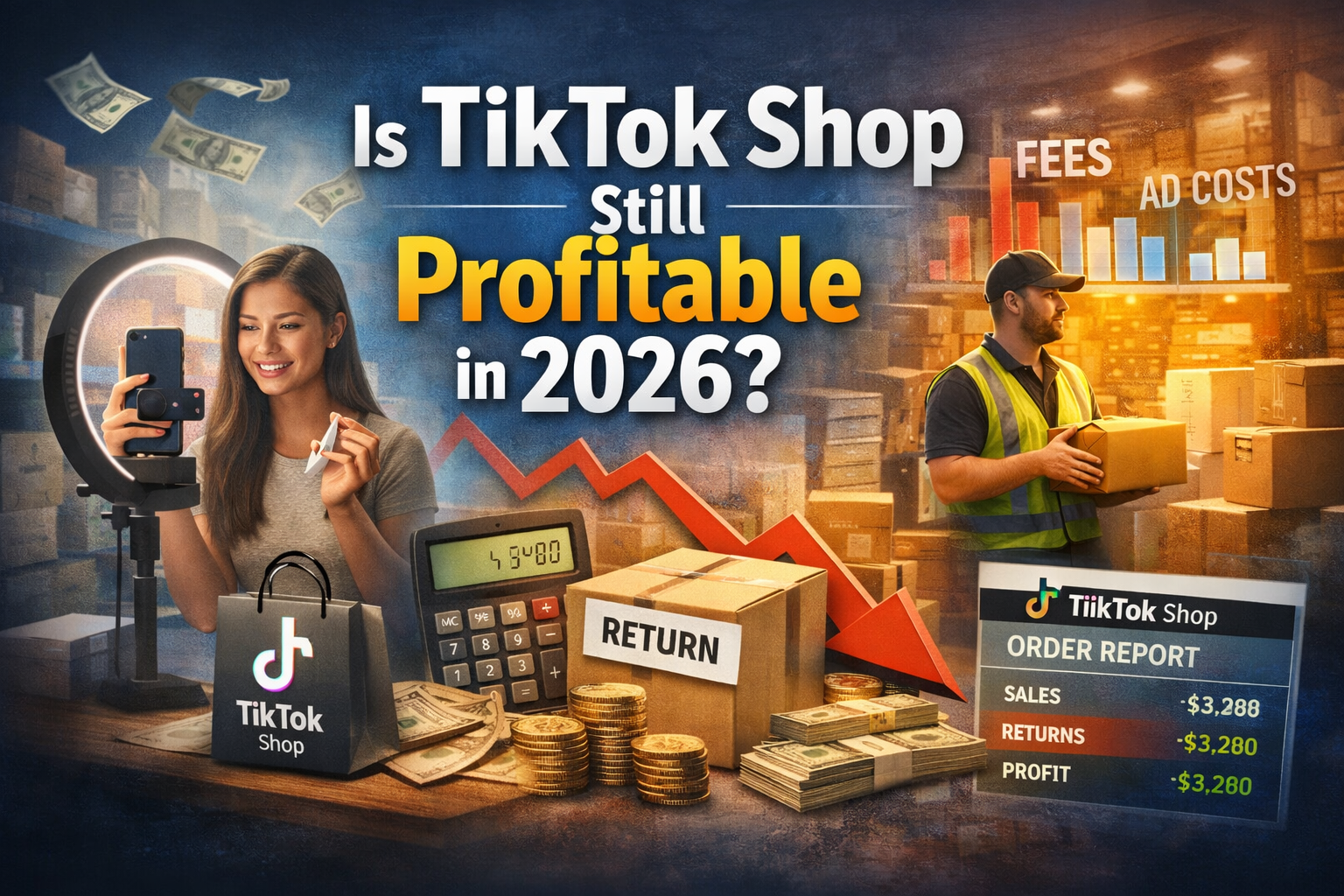
Profit in TikTok Shop in 2026 is no longer about whether you can sell or not. It’s about whether you can remain profitable after the platform takes a cut, and you also need to fund traffic acquisition, content creation, and return policies.
The headline reality: demand is there, but the easy money isn’t
Sellers claim that in 2026, TikTok Shop will become a mature platform. By mature, they mean the platform has set higher standards, and sellers need to treat their shops like a real business.
One of the most noticeable changes in TikTok Shop in 2026 is the difficulty in relying on organic traffic. According to business reports, TikTok Shop has moved away from the free views era and has shifted towards a paid advertising model.
This does not mean that the platform is no longer profitable. It means that TikTok Shop can still deliver explosive sales, but if you’re a seller with thin product margins, a paid traffic model can quickly turn a high GMV business into a low-profit business.
The 2026 profit equation: fees, fulfillment, and friction
Sellers who are profitable in 2026 report that they discuss the same three issues:
1) Platform fees and commissions are no longer a footnote
TikTok Shop has different fee structures depending on the region and the category. In fact, the company has also been updating the fee structure across different markets (for example, the Seller Center has information on the changing commission structure and other promotions for new sellers in different markets).
The only thing the sellers keep saying is not “fees exist”, it’s “fees stack on everything else: processing, discounts, affiliate commissions, shipping, and returns.”
2) Logistics is getting stricter, and this makes or breaks the TikTok Shop account
In the US market, TikTok Shop’s own official policy pages highlight the performance-based enforcement of dispatch timelines. TikTok Shop defines “late dispatch” as “when the order status changes to ‘In Transit’ outside of the dispatch SLA.” The dispatch SLA is linked to metrics such as “Late Dispatch Rate” (LDR).
Additionally, in multiple “2026 Logistics Operation” explainers, it is shown how TikTok Shop is forcing sellers to shift from a “do it your own way” shipping strategy to TikTok Shop’s logistics services.
Thus, the “TikTok Shop got harder” comment by the sellers refers to the fact that if the logistics and operations side of the TikTok Shop account suffers, the TikTok Shop’s visibility and profitability will suffer as well, regardless of the quality of the product.
3) The returns and refunds side of the equation is a larger profit leak than expected
The returns side of the equation is where the “novice profit calculations go to die.” TikTok Shop’s “Seller Center” resources highlight how returns can be auto-approved for “returnable products,” and how response deadlines can auto-approve the refunds if the seller doesn’t act in time.
Moreover, the policies are only getting more complex. In the “Policy Pulse” update of January 2026, TikTok Shop has highlighted changes where “some of the costs of returns, including return shipping and ‘returnless refunds,’” are “shared between TikTok Shop and the seller.”
The only sellers who manage to stay profitable are those who obsess about minimizing returns.
What sellers are saying: TikTok Shop is profitable, but only for the disciplined
From 2025-2026 coverage and platform policy changes, a narrative has emerged among sellers:
Profitable sellers on TikTok Shop are those who think of it as a combination of content studio, performance marketing, and operations.
No profitable seller on TikTok Shop counts on a “viral moment” to save bad unit economics.
They price their products knowing that promotions, creator fees, commission, shipping, and loss from returns exist.
They ship products quickly because they know that if they don’t, their shop performance will be auto-determined by the platform if they fail to meet a deadline.
Meanwhile, sellers who struggle also report the same phenomenon: their sales are up, their net profit remains the same. They “feel” successful because their business looks busy, until they calculate ad spend, affiliate earnings, refunds, and logistics fees.
Advertising in 2026: more relevant, more automated, and sometimes contentious
If 2024 was “viral or bust,” 2026 is more “content and paid distribution.” TikTok’s ad system for Shop has also become more automated. Business publications have reported on the frustration some advertisers have with TikTok pushing its automated ad system, GMV Max, with some concern for transparency and attribution, as well as ROI protection.
For small sellers, the lesson from all this is less about the “politics” and more about the “business.” Success in TikTok Shop in 2026 means learning ad tools, trying creatives nonstop, and tracking profit per order, not just ROI screenshots.
The uncertainty factor for the US is lower than it was, but it is not gone
One more 2026 factor that sellers discuss: the uncertainty factor for the US that hung over the TikTok app is different today. Major news outlets reported that the company finalized an agreement to form a new US entity to keep the app from being banned.
So that is a more stable environment for sellers compared to the “What if the app is gone tomorrow?” uncertainty that has hung over the platform. But sellers also know that the app can change rules quickly, so building an email list, website, or other channels is a common “sleep better at night” recommendation.
So is TikTok Shop profitable in 2026?
TikTok Shop can be profitable in 2026. The market exists, and the scale of the app is no longer a concern.
But sellers who are successful say that profitability is now only for those people who think of it as a business rather than a lottery ticket:
If you are selling a product with high enough margins to cover the costs of the app, creators, advertising, and returns, and your business can scale to meet the stricter demands of the app, then yes, TikTok Shop can be one of the fastest ways to monetize attention into sales.
If you are selling low-margin items, shipping times are slow, or you are counting on organic traffic and don’t worry about returns, then TikTok Shop in 2026 is like running up a hill in the rain.