A couple of years ago, “dropshipping” was a magic word. You could create an online store over the weekend, blend a supplier, and wake up to sales. Then came the wave of viral “it’s dead” articles, typically posted immediately after the owner’s ad account was shut down, a delivery was late, or a customer service issue escalated into a chargeback.
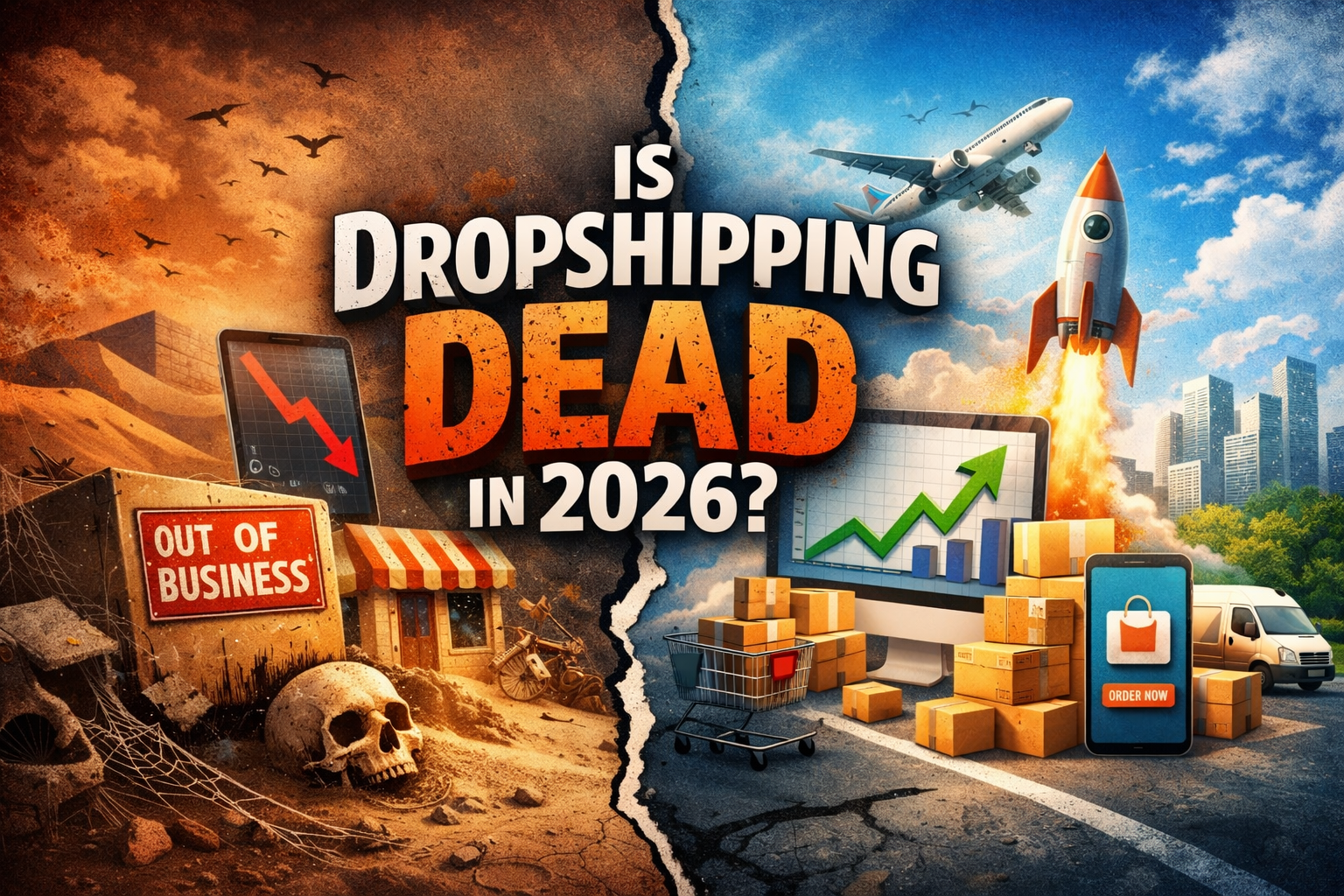
So, is dropshipping dead in 2026?
If you look at the numbers and the evolution of online shopping, the more accurate response is: the easy money is dead. The model is not dead, however. In fact, most reliable market predictions still indicate that the dropshipping industry will continue to grow rapidly at the end of the decade.
But this doesn’t mean that everyone has an equal chance to succeed. In 2026, dropshipping is more like a sport than a gold rush: the game has harder rules, customers are finicky, and time is of the essence.
The first sign that dropshipping is not dead: the market is still growing
If dropshipping were dead, you’d expect to see a shrinking market, not growth. Instead, several industry reports continue to forecast robust growth for dropshipping as a delivery method within the larger e-commerce market. Grand View Research, for example, estimates the global dropshipping market to be approximately 1.25 trillion in 2030.
But now let’s zoom back out: the truth is, dropshipping doesn’t exist in a bubble. It’s riding on top of e-commerce behavior. According to Shopify’s own summary of industry estimates, the state of global e-commerce is that it’s still growing (although growth rates differ by year), with estimated 2024 growth of 7.7% and 6.8% in 2025, with predictions of a rebound in 2026. In other words, people are still shopping online, and sellers are still looking for ways to meet that demand with minimal hassle.
So why does the “dropshipping is dead” myth just won’t quit?
Because the second clue is just as telling: the old rules aren’t working anymore.
What’s really dead: the “long shipping” store business model
In 2017-2021, many stores relied on one trick only: “Run aggressive ads, sell a trendy product, and let customers wait.” In 2026, customers are less patient, and they have more options to buy from. Even Shopify’s own dropshipping fulfillment best practices acknowledge the problem directly: “Shipping times can vary dramatically depending on the destination, taking as long as 60 days in some cases. Delays like these are common.”
And customers won’t care about your excuses for a poor supply chain. They’ll care about the delivery experience.
However, the playing field is harder because customers can get “cheap + fast” from marketplaces that scale. A telling case comes from cross-border e-commerce: “The International Post Corporation (IPC) found that Temu’s share of cross-border e-commerce rose from less than 1% in 2022 to 24% in 2025, making it a leading destination, alongside Amazon, in cross-border e-commerce. That’s a significant increase in three years.” That’s not a small change. It alters what “low price” looks like online, because large platforms can drive down prices in ways that smaller stores can’t.
When a new dropshipper attempts to sell a commodity product with slow shipping, they’re not competing with “other dropshippers.” They’re competing with systems designed to win on price, speed, and habit.
That kind of dropshipping, commodity products, weak branding, long shipping times, and poor customer support is what’s dying.
The truth in 2026: dropshipping is being integrated into modern commerce
The key to dropshipping’s survival is its transformation from “a hack” to “a fulfillment strategy.”
Consider Shopify itself. The company continues to add more merchants and grow its presence, and recent reporting indicates Shopify is heavily embracing AI technology and partnerships, all while continuing to see revenue and merchandise volume growth at a strong year-over-year pace. Regardless of what you think about Shopify, this is significant: platforms like this aren’t making these kinds of investments if e-commerce is on the decline. They’re making these investments because the competition is moving from better ideas to better execution; better targeting, better creative, better ops.
This is also why the dialogue is shifting from “How do I start a dropshipping business?” to “How do I start a small brand and use dropshipping where it makes sense?”
In 2026, successful operators will be doing three things differently:
They will mitigate shipping risk (faster suppliers, domestic fulfillment, or a hybrid inventory model). They create actual trust (clear policies, reasonable shipping times, helpful support). And they market like a brand, not like a pop-up tent.
The pressure point no one wants to talk about
Dropshipping was “cheap traffic + impulse buy.” But paid social is no longer a playground for beginners. Several marketing analyses have found CPM pressure on the major platforms; one analysis of Meta CPM trends reported that Q1 2025 was particularly pricey, with an average CPM of $10.88 and a sharp year-over-year increase. EMARKETER has also noted pricing pressure on major social platforms in 2025, citing changes like AI-driven ad solutions and demand for lower-funnel ad inventory.
This is important because most dropshipping sites have thin margins. When your product is interchangeable, and your shipping is slow, higher traffic costs aren’t just hurting your bottom line; they’re making it disappear.
And when that happens, no one says, “My unit economics are busted.” They say, “Dropshipping is dead.”
So… is dropshipping dead?
Not according to the data. Market predictions and the continued growth of e-commerce make it pretty clear that dropshipping is still on the rise.
But the days of copy-and-paste stores, slow shipping, and easy paid traffic? It appears to be over, pinned between rising ad costs, platform evolution, and super-competitors in cross-border e-commerce.
In 2026, dropshipping is not dead. It’s moved on.
It’s a dead end if you think of it as a shortcut. If you treat it like one tool inside a real commerce strategy, where you build trust, pick defensible products, and design operations around delivery expectations, it can still be very alive.