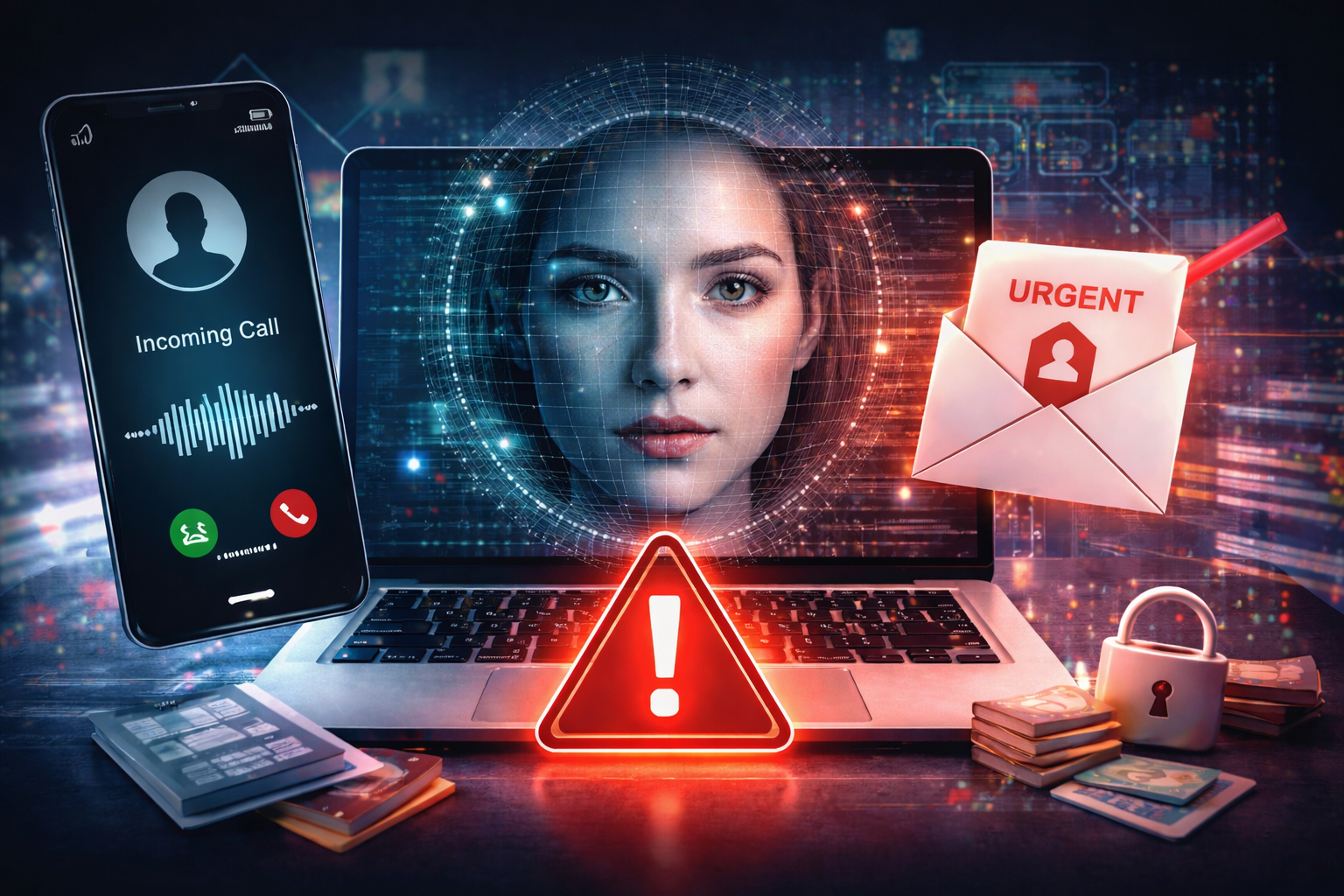
Security experts have long warned that the use of generative AI is making it easier for scammers to create the three things that our brains are hardwired to accept as real: a believable face, a familiar voice, and a normal-looking message. The technology itself is not “evil.” But it can be like a box of costume pieces for scammers, one that is cheap, quick, and improving every month. The FBI has specifically warned that scammers are using AI to create believable voice/video messages and emails that facilitate fraud schemes.
But what does this mean for regular users, especially if you’re not a “tech person” and you just want to stay safe?
The New Scam Isn’t Just “Fake”, It’s “Familiar”
The old scams were often obvious because they looked ridiculous. The grammar was off. The story didn’t add up. The email was screaming “I’m a scam!”
AI scams aren’t like that.
AI technology allows for more believable emails, writing in someone’s style, and creating believable photos or audio. Microsoft has termed this new phenomenon “AI-powered deception,” pointing to large-scale fraud patterns and ongoing efforts to prevent them across its platforms and services.
That doesn’t mean every scary story you hear online is true. But it does mean that the “quality” of scams is increasing, and the feeling they create is the real trick: panic, urgency, and pressure.
AI-Generated Voices: When Your Ears Get Fooled
Voice cloning scams are on the rise because they affect us emotionally. A voice that sounds like a loved one can trick you into acting before thinking.
The U.S. Federal Trade Commission (FTC) has warned that scammers use voice cloning because it makes a request for money or information sound more believable, like a fake call that sounds like your boss asking for bank details, or a “family emergency” call that sounds like someone you love.
The important point is that scammers don’t need hours of audio. Short clips are enough to clone a voice. And many people have audio online without even realizing it, voice notes, videos, and public social posts.
Then the scam follows a predictable pattern: urgency, secrecy, and a fast payment method.
“Please don’t tell anyone.”
“I can’t talk long.”
“Send it right now.”
If you remember nothing else, remember this: urgency is a smoke bomb. It’s meant to stop you from verifying.
AI-Generated Images: When Your Eyes Get Fooled
There are two ways to use AI images.
Sometimes they are “proof.” A fake photo that’s meant to convince you a story is true: a damaged car, a “hospital” scene, a screenshot of a payment page.
Other times, they are “identity.” A scammer makes a fake profile photo for a new social media account, then pretends to be a real person you know, or a romantic interest, a recruiter, a “doctor,” a “lawyer,” or anyone who can gain your trust.
Law enforcement and financial regulators have warned that synthetic media can facilitate fraud and impersonation, including tactics to circumvent identity verification. For instance, the U.S. Treasury’s FinCEN has highlighted how criminals might employ generative AI to produce fake documents, photos, and videos to circumvent verification systems.
AI images can be crystal clear. That’s why “it looks real” is no longer a good verification standard.
AI-Generated Emails: The Scam That Walks Into Your Inbox as It Belongs There
Email is still where a lot of serious fraud occurs, because email is how business gets done: invoices, payments, contracts, deliveries, updates.
There’s a lot of talk in the security community about “BEC” scams (business email compromise), emails that seem to come from a boss, a colleague, or a vendor, asking for cash or confidential data. The FBI has long warned about these scams and their potential harm.
But now, with AI, the writing is more believable. Rather than clumsy grammar, the phishing email may be sophisticated, composed, and “just like your boss.”
And it’s not just corporations. Regular people get fooled too: fake delivery emails, fake bank notices, fake “password reset” emails, fake tax notices.
The aim is usually the same: get you to click a link, enter a code, or send cash.
The Child-Simple Rule: Don’t Trust the Message
When you get a weird message, don’t wonder, “Is this legit?”
Wonder, “Am I checking this out in a secure way?”
Because even if it looks legit, the best course of action is to use a method that the scammer can’t interfere with.
Here are the methods that the experts keep coming back to:
Call Back Using a Trusted Number
If you receive a frightening call or voice message, hang up and call the person back from a number you already had saved (or from an official website). Not the number that just called you.
Use a “Family Password”
It’s ridiculous until you need it. A simple code word your family agrees on, something a scammer wouldn’t know, can instantly shatter the spell of a voice clone.
Slow Down Payments
Scammers love instant transfers, gift cards, crypto, and “urgent invoice changes.” If money is involved, slow it down and check with a second method.
Treat Links Like Open Traps
If an email says “log in now,” don’t click the link. Go to the site by typing the address yourself or using the official app.
Turn On Strong Account Protection
Multi-factor authentication (MFA) helps, especially app-based or hardware-key methods. It’s not foolproof, but it increases the cost for scammers.
What This Means for Your Daily Life
We’re entering a world where “seeing is believing” is less true than it used to be.
What experts are saying is that you don’t need to panic or stop using the internet. They’re saying you need to change your habit from reacting to checking.
The Bottom Line
AI-generated images, voices, and emails are so good because they imitate something human: familiarity.
Scammers don’t win because they’re smarter than you. They win because they make you hurry.
So the best habit in 2026 is a simple one: When the message is urgent, emotional, or expensive… check it with a method you control.
Are you curious about what’s shaping the world next? Click here to explore more timely, trusted news stories from around the globe.