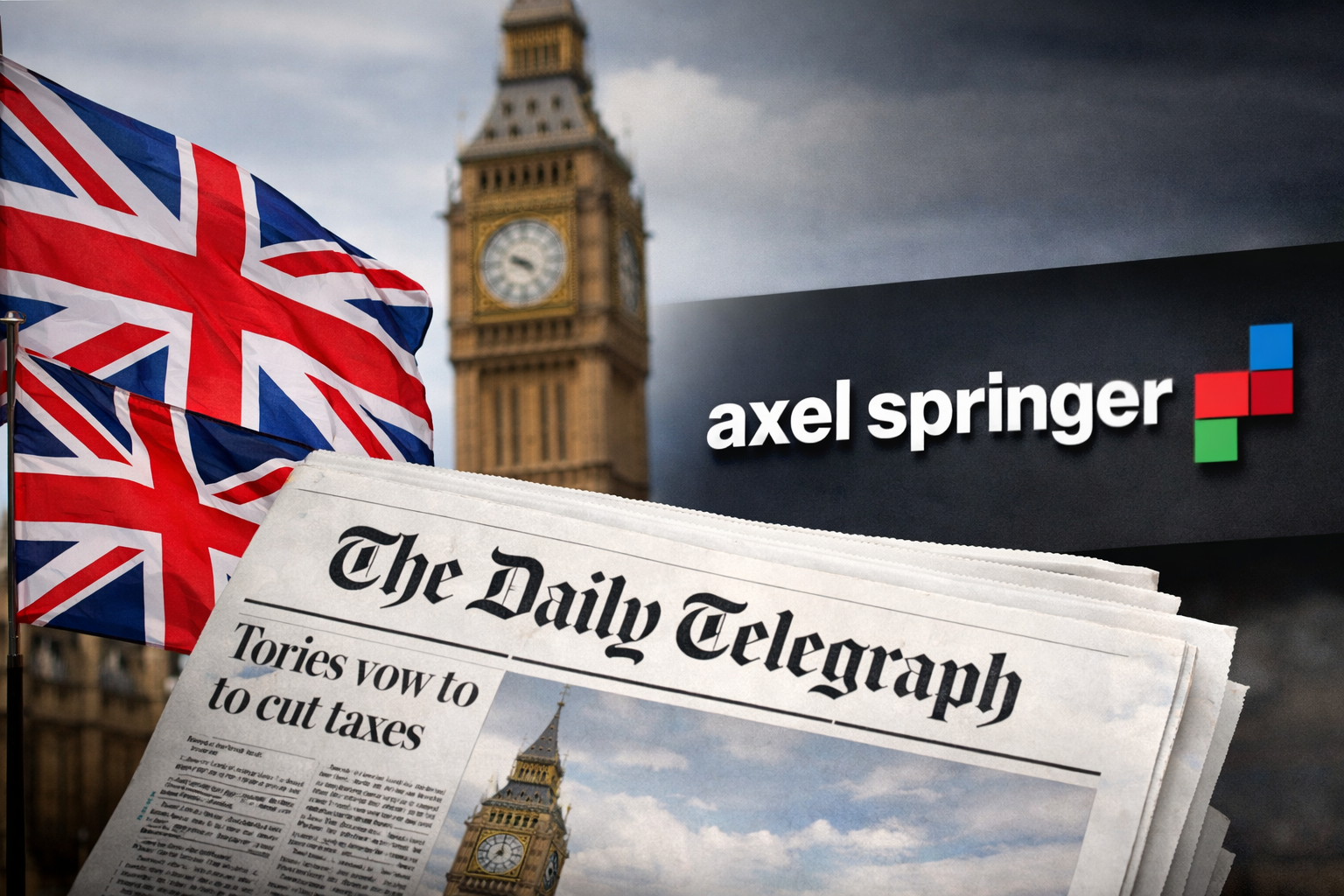
When people think of media conglomerates buying other media conglomerates, it does not always seem like a very exciting topic. One company buys a media outlet, and the transaction is done. However, the sale of the Telegraph to German media conglomerate Axel Springer is about more than just a media company purchasing another media company. It is a political story, a media power play, and a media ownership play. Axel Springer, as of March 6, 2026, has agreed to purchase the Telegraph Media Group in a deal worth 575 million pounds in cash, according to the company and various news sources, although the deal is still pending approval.
In order to fully grasp the significance of the sale of the Telegraph to Axel Springer, it is necessary to first discuss the significance of the Telegraph in the United Kingdom. It is one of the most famous conservative newspapers in the United Kingdom. For a number of decades, the Telegraph has had a powerful voice in politics, in the conservative party, and in the minds and hearts of the British people. Thus, the sale of the Telegraph to Axel Springer is about politics and power.
What exactly has happened?
Axel Springer, the German media group that also owns Politico, Business Insider, Bild, and other notable publications, announced on March 6 that it had entered into an agreement to acquire the Telegraph Media Group for 575 million pounds. According to the announcement, the group aims to expand the Telegraph while maintaining its character. In fact, the CEO, Mathias Döpfner, said that owning the paper is both a privilege and a duty. Various news agencies, including Reuters, Sky News, AP, etc., have also reported the acquisition, stating that the sale price is 575 million pounds.
Clearly, the above scenario sounds rather simple, but the journey to the acquisition has been rather messy. The Telegraph Media Group had been in the middle of an ownership saga after the Barclay family lost control of the paper due to their debts, which amounted to £1.16 billion.
The paper then got caught up in a highly controversial process involving RedBird IMI, a US-Emirati investment vehicle. This situation prompted a major political controversy in Britain because politicians were uncomfortable with the fact that a foreign state investor could potentially own a major newspaper in the country.
Why was the earlier Telegraph Saga so controversial?
The British government stepped in to ensure that no foreign state owned, controlled, or influenced newspapers in the country following the RedBird IMI controversy.
Subsequent regulations were put in place to ensure that investments were within the 15% threshold, but the basic political principle remained the same: newspapers were not the same as any other asset because they were involved in the democratic debate.
The sale of the Telegraph was, therefore, a major controversy in the country over something much larger than the brand itself. The real issue at the heart of the controversy was whether a newspaper that played a role in the political debate in Britain should ever be owned by money from outside the country and the state.
This is why the earlier route to ownership was highly controversial. Even those who were normally in favor of foreign money were more cautious when it came to the media because this involved the elections and the national debate itself.
Why is Axel Springer Different?
Axel Springer is a foreign entity, but it is not a foreign state. And this is the crux of the matter. While a foreign private media conglomerate may certainly pose some questions, it is a very different kind of question from a foreign state-related investor. The current deal is also said to have a less complicated approval route compared to the other options because it does not pose the problem of state influence, which was the issue in the aborted attempt by RedBird and IMI.
It is also reported that Axel Springer’s offer was stronger than another bid by media group DMGT, which owns the Daily Mail, and that this bid would have been subject to review under media plurality rules because it would have meant more right-leaning newspapers under one British media group’s umbrella.
In simple words, Britain had two fears regarding this deal. The first fear is related to foreign state interference. The second fear is related to media group concentration. Axel Springer seems to have offered a deal that has addressed the first fear and might be easier to defend against the second. This is an inference based on the regulatory background and reporting surrounding the two media groups’ competing bids. That is all. This is not to say that this deal is necessarily good or bad from a political perspective. It is simply to say that it is easier to sell.
What could change next?
The first thing that could change in the near future is that the deal is by no means done and dusted. There are regulatory hurdles to clear before the deal is complete. However, if the deal does go through, the UK could end up with a Telegraph that is more globally ambitious, more digitally focused, and more connected to the broader trans-Atlantic conservative media scene.
The company already owns major brands with significant influence in Europe and the US, and this deal could potentially make the Telegraph a more important player in English-speaking politics beyond the UK.
The larger significance of the deal
Ultimately, the significance of the deal between Axel Springer and the Telegraph is that it is the crossroads of money, media, and power. The money is obviously £575 million. The media aspect is also obvious; it is one media empire buying another. But the power aspect is what makes this deal significant beyond the normal boundaries of a media deal. The Telegraph is not just a media outlet; it is a voice in the country. And when a voice changes hands, politics takes note.
Click here to know what’s interesting happening around the world.