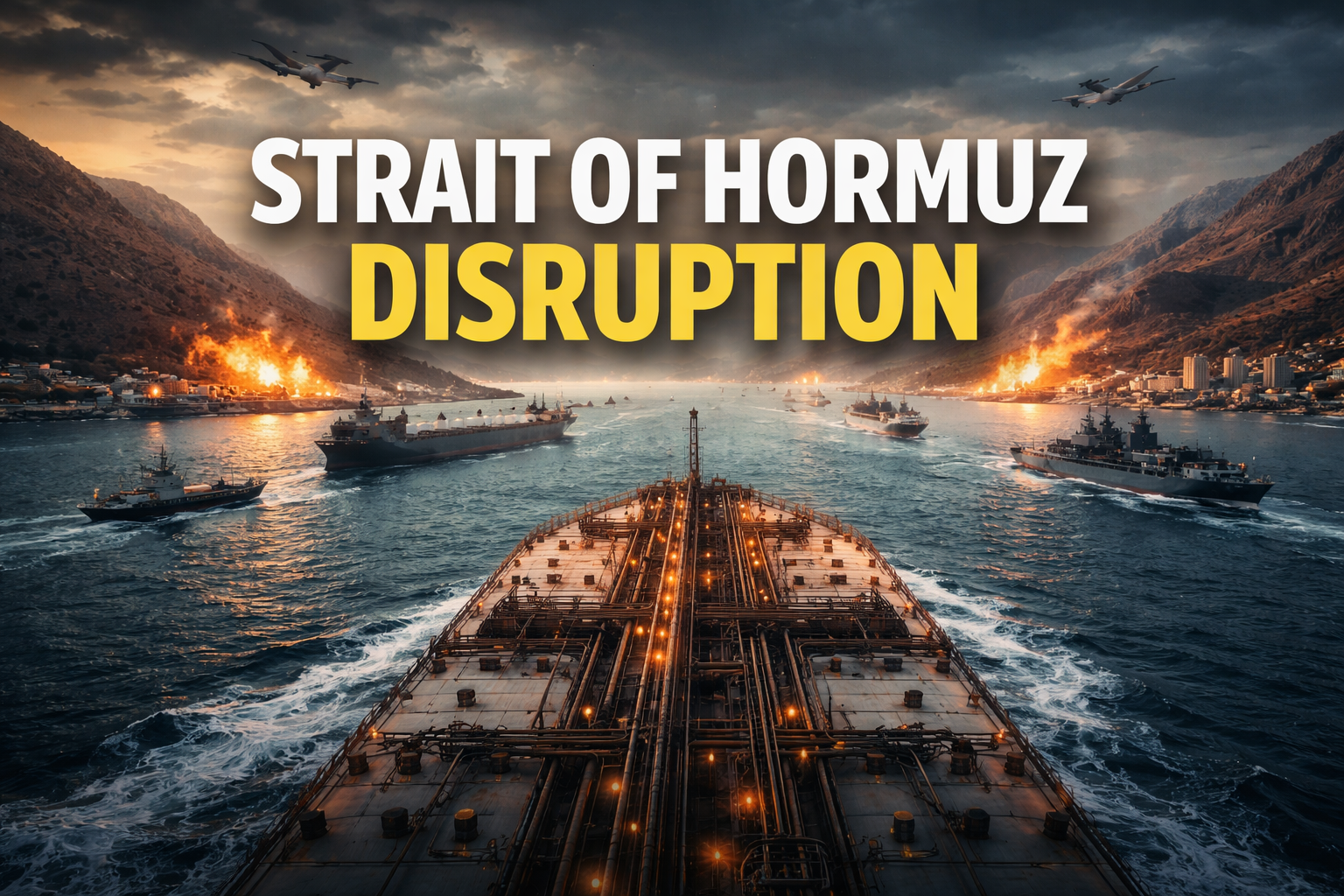
The Strait of Hormuz is a name that might sound like a faraway place on a map. But in reality, it is a small place that has the power to make the entire world feel a shock. It is a waterway that connects the Persian Gulf with the Gulf of Oman and the Arabian Sea, situated between Iran and Oman. Oil tankers and gas ships pass through this waterway every day, carrying oil from the Gulf countries to the rest of the world.
According to the U.S. Energy Information Administration, oil passing through this waterway in 2024 and early 2025 represented more than a quarter of the world’s seaborne oil traffic and about one-fifth of global oil consumption, including petroleum products. According to the International Energy Agency, close to 20% of global LNG trade also passed through this waterway in 2025. This is why it is called a chokepoint.
The world can be compared to a human body. The blood represents oil, and the Strait of Hormuz is a small artery in this body. When this artery is constricted, everything far removed from it starts to feel weak. Factories do not stop running in a second, nor do cars stop running on the road in a second, but prices start to rise, shipping becomes dangerous, and fear starts to spread through the markets very quickly.
Why is the World Worried Right Now?
As of March 6, 2026, the Strait of Hormuz is no longer just a theory in an economics textbook, as it is being played out as part of a current crisis. Reuters has reported that the conflict with Iran has greatly impacted the flow of ships through the Strait of Hormuz, with ships being stranded, the flow of ships being greatly reduced, and the energy markets being greatly impacted.
Additionally, Brent oil is up 24% for the week, trading at $90 per barrel, one of the largest weekly percentage gains since 2020, as energy markets are being impacted by concerns related to the Strait of Hormuz.
This is important to note, as markets will panic, and they will panic long before the door is actually closed. They will panic if they sense danger, and trade will be affected, even if no actual blockade has been announced. Lloyd’s List is reporting that the flow of ships through the Strait of Hormuz is down more than 80% compared to a week ago, as of March 1, illustrating how quickly trade is impacted when danger is perceived.
How can one waterway influence fuel costs throughout the world?
The answer is simple: the more difficult it is to transport the fuel, the higher the fuel costs are likely to be. Oil is traded throughout the world. So even countries that are not in the Middle East can expect to see their fuel costs go up if the market believes that fewer barrels of oil will reach the buyers in time.
Even natural gas markets are not immune to the effects of the Hormuz disruption. This is especially true since Qatar is one of the largest natural gas producers in the world, and almost all of its exports are transported through the Hormuz waterway. In fact, the IEA reports that more than 112 billion cubic meters of LNG exports went through the waterway in 2025.
When oil and gas costs go up, the effects trickle out. Airlines have to pay more for fuel. Shipping companies have to pay more to transport their goods. Factories have to pay more for fuel and transport. Finally, shops put up their prices.
This is the way in which the initial disruption in this particular small sea route can escalate into a cost-of-living crisis for people who may not even know the location of Hormuz. IMF officials have already cautioned that the broader Middle Eastern conflict could impact growth and inflation, depending upon the duration of the disruption and the severity of the impact on the energy sector
Why is Asia especially exposed
Asia is especially vulnerable to the Hormuz disruption because it consumes such a vast quantity of the energy passing through this particular route. The EIA has previously announced that the Asian markets are the primary consumers of the Oil passing through the Hormuz route. The IEA announced that in 2025, almost 90 percent of the volumes passing through the strait are destined for Asia. Additionally, the Asian Development Bank announced that even a short disruption in the Hormuz route will pose risks to the Asian economies in terms of higher energy costs, lower demand, and higher financial volatility.
This means that the impact is not confined to the Middle East. It extends to India, China, Japan, South Korea, and a number of other countries in the importing world. If oil prices rise, transportation costs rise, and manufacturing costs rise. If LNG prices rise, electricity prices rise, and industrial fuel prices rise. This is a chokepoint, and it has implications for half the world.
Can countries use another route?
There are some oil pipelines that can bypass the strait, especially in Saudi Arabia and the UAE. The spare capacity is, however, much smaller than the amount of oil normally passing through Hormuz. The EIA states that about 2.6 million barrels a day of Saudi and UAE pipeline capacity could be available to bypass the strait in case of a disruption. However, this bypass capacity is limited, with only Saudi Arabia and the UAE having operational crude oil pipelines that could be used to bypass the strait.
Now compare this with the normal volume of traffic passing through Hormuz. Daily, some 20 million barrels of oil and petroleum products pass through the strait. So, bypass routes are certainly useful, but they are still a long way off from providing an alternative to the whole waterway. That is why the problem cannot be fixed with a simple bypass, as it is like trying to drain a river with a few small tubes.
Click here to know what else is happening around the world.