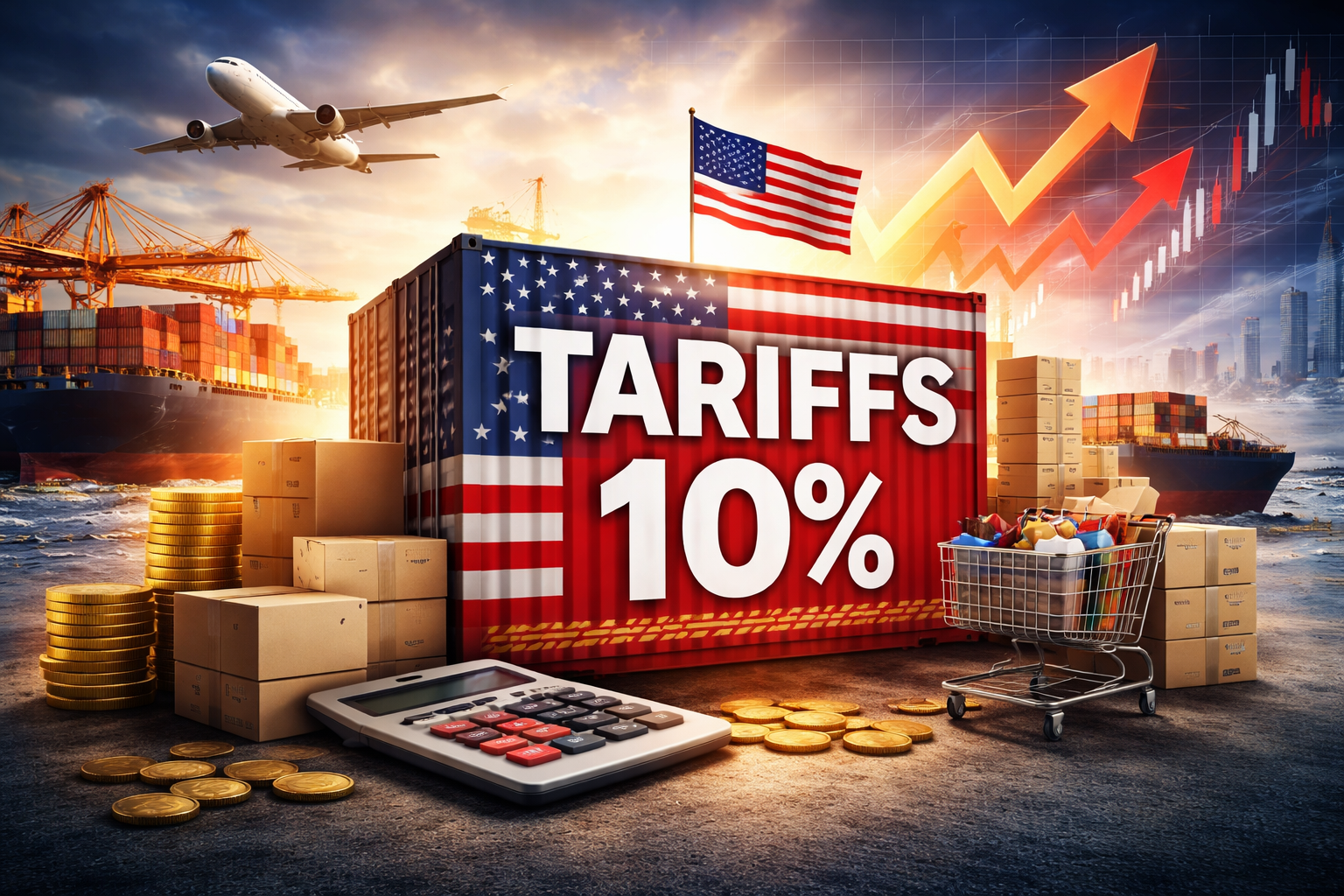
A typical week might see a ship arrive at a US port, carrying thousands of common items: sneakers, household items, phone accessories, bike parts, toys for kids. Most of these items look pretty uninteresting, just boxes. But this week, boxes began arriving at US ports with a new “fee sticker” attached.
This sticker is a 10% tariff.
And even though it might seem like something only TV economists fight over, tariffs might quietly appear in everyday life, like when a price tag goes up, or when online shopping no longer seems quite so “cheap.”
What happened this week?
The US government began collecting a temporary 10% import tariff on many items arriving in the United States. This began on February 24, 2026 (12:01 a.m. Eastern Time) and will continue for 150 days.
This is happening under a provision of law known as Section 122 of the Trade Act of 1974, which allows for a temporary tariff (up to 15%) for a short period of time if the government determines there is a “serious payments” or trade balance issue.
It’s also happening because of a major change in the US Supreme Court’s ruling against a previous, sweeping set of tariffs that had been put in place under a different law (IEEPA). The new 10% tariff is part of the administration’s effort to rebuild its tariff system under different laws.
The Basics of Tariffs
Let’s say there’s a rule at your school:
“If you bring a toy from outside the school, you have to pay 10 rupees to bring it inside.”
That’s more or less what a tariff is.
A tariff is a kind of tax on things that come from outside the country, a fee that’s added when those things cross the border. In this example, the fee is 10% of the item’s worth (that’s what “ad valorem” means).
So, if a company brings in a product that costs $100, a 10% tariff tacks on another $10 at the border, the company has to pay that first, but the bigger question is: who ends up paying it later?
Will prices go up?
Yes, often, but not always in a straightforward, immediate way.
Here’s the easiest way to understand it:
The importer pays the tariff.
The importer does not want to lose money.
So they might increase the price they charge the store.
The store might increase the price you pay.
That’s why many economists believe tariffs will ultimately affect consumers by increasing prices (or reducing discounts).
But prices won’t go up like a light switch. Sometimes they go up slowly, sometimes in certain product categories, and sometimes not at all, at least not right away.
Why prices might go up quickly for certain items
Suppose it’s a product that already has low margins (not much profit), even a small additional charge will cause prices to go up quickly. Think of cheap household items that are sold based on price.
Why prices might not go up right away
Some companies will have old stock in warehouses that they bought before the tariff came into effect. They might sell that stock first. Others might absorb the cost for a while to keep from losing customers.
So you might see prices go up a little at first, and then a lot later, especially if the tariff stays in place, expands, or goes above 10%.
Wait, does the 10% tariff apply to everything?
No. There are some very important exceptions.
The White House fact sheet lists types of goods that won’t be subject to the temporary import duty, including (but not limited to) pharmaceuticals and ingredients, certain electronics, passenger vehicles and certain auto parts, certain aerospace products, informational materials such as books, and certain energy products and critical materials.
There are also trade agreement exceptions. For example, goods that meet USMCA requirements from Canada and Mexico are not subject to this temporary duty.
So the “10% on everything” headline is a good starting point, but the actual effect will depend on what you’re buying and where it’s coming from.
The sneaky part: online shopping and small packages
One thing that can affect regular folks sooner rather than later is what happens to low-value packages, the kind of thing that people order online in small packages.
As part of the tariff action, the administration reiterated the suspension of duty-free “de minimis” treatment for low-value packages (including postal packages), which means that some small packages that used to fly under the radar without paying duties may now have to pay the import duty as well.
In simple terms: if you’re used to ordering low-cost goods from overseas and having them shipped to you without paying any additional fees, this may no longer be the case.
What might this mean for trade with other countries?
Trade is like a large group project. If one member of the group changes the rules, the entire group responds.
When the US increases tariffs, other countries have a few choices:
- Negotiate (seek exemptions or better terms)
- Retaliate (impose tariffs on US exports)
- Change supply chains (buy and sell more with other partners)
Even the uncertainty can create waves. Companies that import products might put off orders, expedite shipments, or renegotiate contracts because they don’t know what the rules will be next month. Reuters reported confusion early on because the administration considered raising the tariff, but customs regulations suggested the launch level would be 10%.
The bottom line
A 10% tariff may seem like a straightforward number, but it’s actually the beginning of a domino effect.
For some goods, you may hardly notice. For others, perhaps those that depend on slim profit margins, quick imports, or small online orders, the tariff may manifest as higher prices, fewer discounts, or longer waits.
But if the tariff escalates above 10% for some countries or if other countries impose tariffs in retaliation, the news cycle may shift from “a policy headline” to “why does everything feel more expensive?” Click here for more updates about what’s happening around the world.