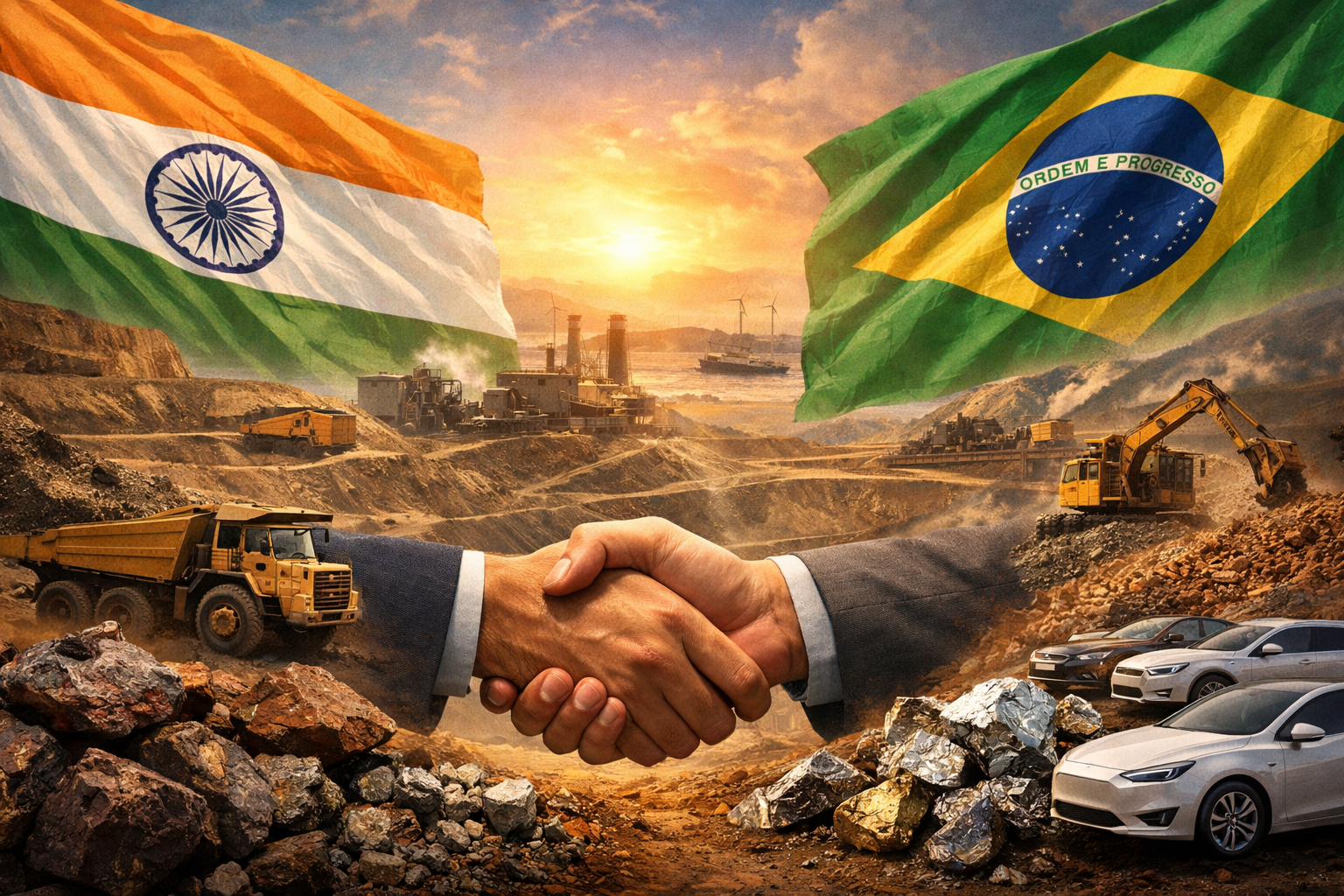
When India and Brazil make a deal on minerals, it can make a difference in everyday life. The cost of cars, the time it takes to build roads, or even how quickly new gadgets appear on store shelves. This week, the two countries agreed to strengthen their cooperation in mining, minerals, and critical materials, which they described as a means of securing more “resilient” and “diversified” supply chains and boosting trade.
How it works: Imagine the world’s factories as a massive kitchen. If the kitchen can’t get its essential ingredients, there’s no dinner. In today’s world of manufacturing, those “ingredients” include iron ore for steel and rare earths for high-tech parts.
What did they sign, and what does it mean?
During President Luiz Inácio Lula da Silva’s trip to New Delhi, the two countries signed an agreement to strengthen cooperation in mining and minerals, including encouraging investment in exploration, mining, and related activities related to steel and raw materials.
They also signed a non-binding memorandum of understanding on rare earths and critical minerals. Non-binding agreements may sound like a backroom deal, but they’re often the first step in big partnerships. They outline a common goal, and then the work begins to figure out how to make it happen.
Why “mining news” suddenly matters to supply chains
Supply chain crises usually happen far from the factory floor. If a mineral hits a snag at the start of the supply chain, it affects everything that happens further down the line. Projects get delayed, prices go up, and manufacturers have to find new sources.
That’s why both governments used the words “resilient” and “diversified” when talking about this agreement.
Why India is so concerned about this right now
India is in a big construction cycle; infrastructure, real estate, manufacturing, and steel are right at the center of it. Reuters said India has a steel production capacity of 218 million metric tons and is increasing production to keep up with growing domestic demand.
More steel production means more access to mineral resources and better mining partnerships. It also means that India is looking for ways to mitigate risks associated with supply chain disruptions, particularly for “critical minerals” that go into modern technology and clean energy solutions.
India, like other nations, has also been working to diversify its dependence on a few sources for these resources (and the processing required to make them into usable resources). Having more suppliers is like having more than one store in your neighborhood; if one goes out of business, you still get to eat.
Why Brazil is important to this story
Brazil is not just an important market; it is also an important resource country. It is one of the biggest iron ore producers, which is important for any country that is expanding steel production.
And Brazil also wants to play a larger role in the next generation of minerals. The Associated Press reported that Brazil has the second-largest reserves of rare earths in the world. That puts Brazil at the table when it comes to discussions of EVs, renewables, and advanced electronics.
But minerals in the ground are only the first step. The harder part is creating the supply chain to turn rocks into parts: exploration, mining, processing, and then manufacturing. Partnerships can help get from “we have it” to “we can supply it.”
The hidden strength of rare earths
“Rare earths” is a phrase that sounds like the stuff of fantasy, but it is real and surprisingly valuable. These elements are used in high-performance magnets that appear in electric motors and a wide variety of electronics. If a nation can gain access to the minerals and the processing, it can safeguard its own industries from being harmed.
This is part of why the AP reported the agreement as being about strategic autonomy. Both nations want to have more control over the building blocks of modern technology, rather than being forced to rely on a single supplier.
What might change for supply chains (and what won’t)
This agreement won’t bring new mines out of the ground overnight. Mining takes time. But it might just change the supply chain landscape in three ways:
First, it might allow more investment and joint ventures in exploration and mining, which Reuters said was one of its aims.
Second, it might open up more predictable supply chains for key materials like iron ore for steel and critical minerals for new industries. That makes life easier for manufacturers and governments.
Third, it might facilitate technology-sharing. AP said the partnership might include artificial intelligence applications related to minerals work: think smarter mapping, improved forecasting, and more efficient operations.
What won’t change quickly is the tough midstream process: processing and refining. The world needs more than ore; it needs usable materials. That’s where many supply chains are still clogging up.
The trade and geopolitics of the handshake
This is also a trade story. Reuters reported Narendra Modi saying that “both sides want to increase bilateral trade from current levels of $15 billion to above $20 billion in the next five years.”
And it’s a geopolitical story. When nations make minerals agreements, they’re also making a statement: “We’re building options.” In a world where supply chains have been weaponized through tariffs, export controls, and surprise restrictions, “options” are a kind of security, especially for nations that partner together in groups like BRICS.
What to watch next
If you want to know if this agreement becomes “real” (not just a pretty photo shoot), watch for announcements from companies: joint ventures, exploration licenses, and investment plans. Also watch for which minerals get priority mentions, such as iron ore, rare earths, or other “critical” materials. And finally, watch for announcements on processing projects, since that’s where raw rock gets turned into something a factory can actually use.
Bottom line
The mining and critical minerals partnership between India and Brazil is more than just a ceremonial agreement to sign. It’s a wager that the coming decade will be shaped by which countries can best access and transport critical materials. India needs resources for steel, as well as a safe passage for critical minerals. Brazil hopes to leverage its strength in resources to build lasting industrial power. A partnership that translates into actual projects and actual processing power could, over time, remake pieces of the supply chain puzzle.Want more story-style explainers on the biggest global headlines? Click for more trending news.