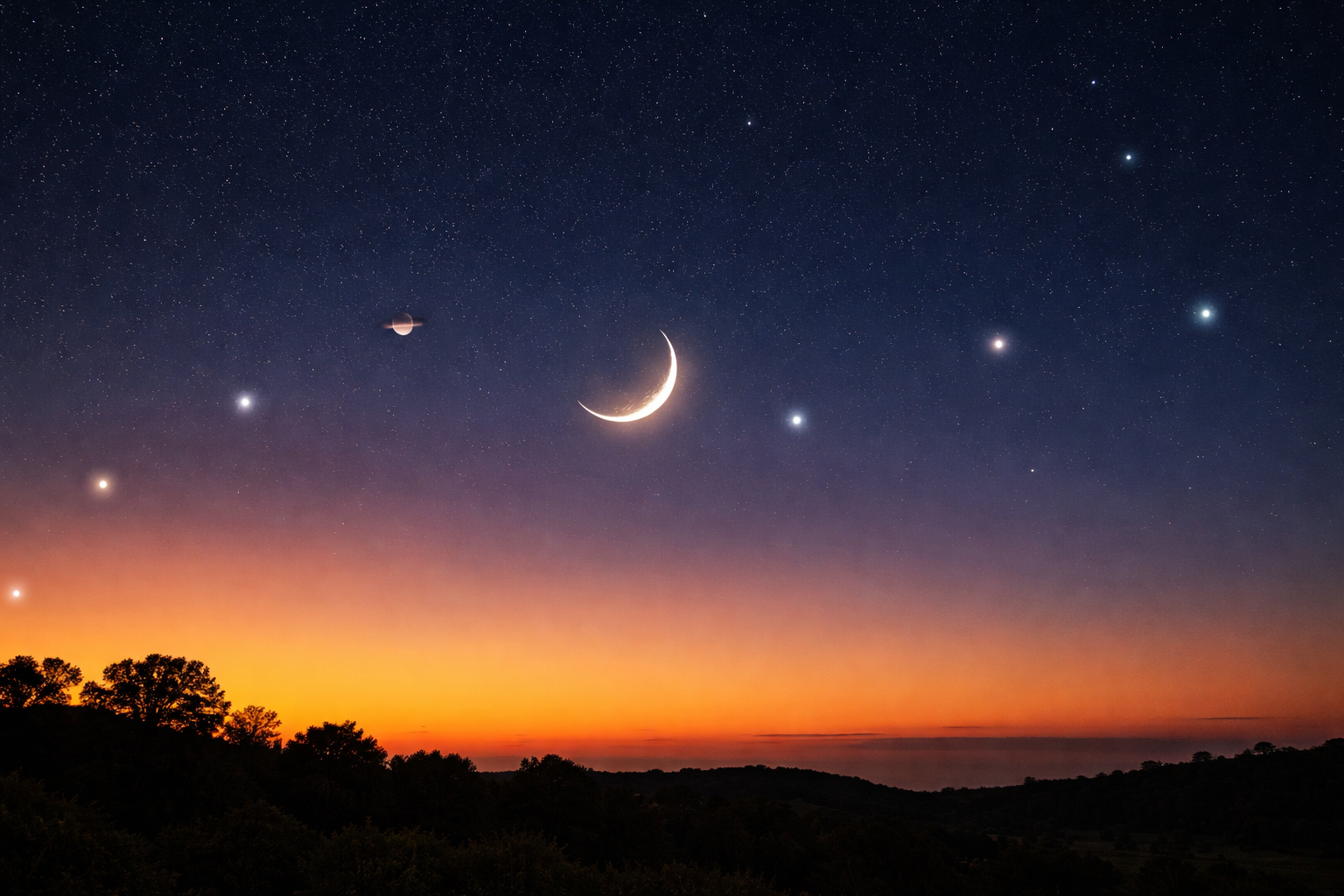
On the night of February 28, go out not long after sunset, and you might witness a “planet parade” where several planets are visible in one night, with the Moon joining the show. This phenomenon is known as planetary alignment. It won’t form a straight line but rather a curved path in the sky. It’s a good reason to go out and appreciate the night sky.
What’s happening on February 28?
Six planets: Mercury, Venus, Saturn, Jupiter, Uranus, and Neptune are visible above the horizon in the evening, and the Moon is also out. Some of these planets will be visible with ease, while others will be hard to see because of their brightness or being masked by the twilight sky, unless you have a pair of binoculars or a small telescope.
Why planets seem to “line up.”
According to NASA, the planets revolve around the Sun in a plane that is almost the same as a flat plane. When viewed from Earth, this plane appears as a line in the sky called the ecliptic. Hence, planets will appear to line up along this line.
Why does this night feel like a big deal
This is not a situation where the planets are actually aligning in space. This is a viewing geometry situation where the position of the planets in their orbits and the position of Earth at the time of observation come together. What makes this night special is that it brings together multiple planets in one night, along with the Moon, so that new observers don’t have to stay up all night to see them.
What you can expect to see
Begin with Jupiter. It is the easiest object to spot and, on February 28, will be high in the eastern sky at sunset, near the bright stars Castor and Pollux in the constellation Gemini. The Moon will be high in the eastern sky, below Jupiter.
And now, the more challenging objects: Mercury, Venus, Saturn, and Neptune will be low in the western sky just after sunset. Venus will be very bright and will serve as your “pointer star,” but it may be obscured by trees or buildings because it will be low in the sky. Mercury will be much less bright and will quickly disappear in the twilight sky; it will be easier to spot earlier in the month (around Feb 19-20), but by Feb 28, it will still be a challenge. Saturn will be low and moving towards the Sun’s glare, and Neptune will be much fainter (magnitude 8), so Neptune will usually require a telescope to spot.
Uranus is between the western group and Jupiter. It is not as bright as Jupiter or Venus, but it can be distinguished with binoculars, and according to BBC Sky at Night Magazine, it is located below the Pleiades star cluster in the constellation of Taurus.
So, it is “six planets,” but do not worry if you can clearly see only two or three of them. The exciting thing is to attempt to see them and realize that each bright “dot” is another planet.
Why some planets are hiding in the twilight
If you go out and think, “I can see only one planet. Where are the other five?” then that is perfectly normal. The inner planets and Saturn are near the direction of the Sun in late February, which means that they are located in the bright part of the sky shortly after sunset. Your eyes are struggling with the brightness of the twilight sky, the low horizon, and the city lights. Therefore, Space.com mentioned, the “parade” of February 28 may be a bit overhyped for this very reason.
When to look so you don’t miss it
The western planets are a race against the horizon. Many sources suggest looking about 30-60 minutes after sunset: late enough for the sky to darken, but before Mercury, Venus, and Saturn disappear below the horizon. Your timing will depend on your location and the weather.
Jupiter and the Moon are more flexible. Even if the west is a bust, you can still look forward to a bright Jupiter and Moon combination once the sky is fully dark.
Where to look, for beginners
First, look west and spot Venus low in the sky. Once you spot Venus, look around it for other faint dots: Mercury and Saturn will be in the same vicinity, but much harder to spot. Neptune will be close to Saturn, but you’ll need a telescope to spot it.
Next, turn to the east. Jupiter should be high and bright, with the Moon below it. Space.com points out a great bonus: if you have binoculars, you might spot the Beehive Cluster (M44) as a soft, sparkly smudge below the Moon.
If you have binoculars, look for Uranus, nestled under the Pleiades, roughly in the middle of the sky between west and east. If you can’t spot it, don’t worry, it’s a faint planet.
A few easy tips that make a huge difference
Take five to ten minutes to give your eyes a break from bright indoor lighting. Try to position yourself so that streetlights are behind you, and if you’re using binoculars, lean on a railing or wall to steady your arms. If you’re using a sky app, turn down the brightness so you’re not “resetting” your night vision. Your clear horizon is the secret to your success tonight.
A quick safety reminder
Because some planets are visible low in bright twilight, some people tend to start too early. Sky at Night urges that viewing the setting Sun with unfiltered binoculars or a telescope can be very damaging to your eyes. Wait until the Sun is fully below the horizon before using your optics, and don’t point them low in the direction the Sun disappeared.
If you miss February 28, you haven’t missed the show
The “parade” develops over several days. February 28 is a popular night because Mercury and Venus become more accessible late in the month, but other favorable nights in late February can be enjoyable too, sometimes even better if the haze is lower or your horizon is clearer.
If you do get to see it, take a quick picture, perhaps just Jupiter and the Moon. It’s a small keepsake of a large concept: other worlds are sharing your sky, right on schedule.Want more sky events and big stories explained simply? Click for more trending news.