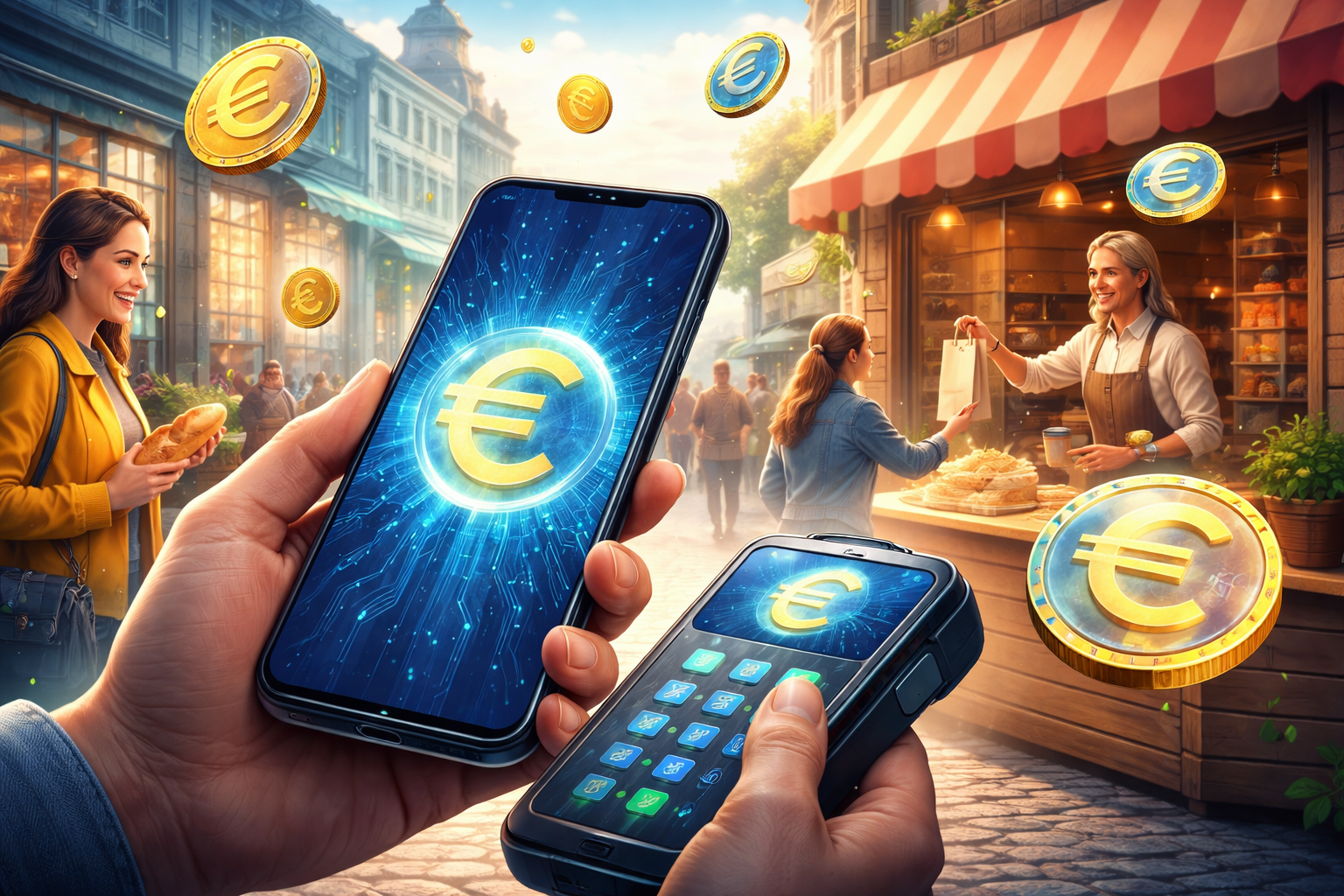
It’s a rainy afternoon in a small European town. A kid dashes into a bakery, points at a warm chocolate bun, and the baker smiles: “That’ll be two euros.” The kid reaches for a coin, then remembers it’s gone. No problem, Mom taps her phone, beeps, and the bun is paid for.
Now there’s a third option. A “digital euro”: money from the central bank, made for moments like this one.
That sounds simple. But the moment people hear “digital,” they ask the real questions: “Will cash disappear? Will someone watch what I buy? Will my bank still matter? What if the internet dies?”
What exactly is a digital euro?
Think of money as having two flavors. One is public money, such as cash, issued by the central bank. The other is private money, such as the amount in your bank account, which is a promise made by your bank.
A digital euro is proposed as public money in a digital form. It’s designed for small, fast, and widely accepted transactions so that people can continue to use “official” money even if cash is used less often.
Is this happening tomorrow?
No. It’s not a flip of a switch overnight. Europe is still constructing the rules and the infrastructure. Many public timelines mentioned among central bank sources indicate pilots after legislation, and a system ready for a possible first issuance around 2029. In simple terms: “later this decade.”
Will it replace cash?
This is the fear that appears everywhere: “They’re going to take my notes and coins.”
The aim is the opposite: to offer a new choice, not replace existing ones. If all goes well, you can keep your cash, keep your cards, and get your digital euro, another way to pay in the euro.
Will my transactions be traced?
This question isn’t asked because people are up to no good. It’s asked because money is a private matter. Your shopping basket might betray your health, your relationships, and your concerns.
The team claims that privacy is a central aim. The most talked-about functionality is offline payments.
What are offline payments, and why do they matter?
Offline payments mean that the digital euro could function even when there’s no internet connection, say, in a subway tunnel, during a blackout, or in an area with a poor signal.
Here’s the crucial bit: offline payments are said to offer cash-like privacy. In the straightforward version, only the sender and the receiver know what’s going on, just as if you were passing over a banknote.
So, offline is important twice over: first, for its reliability, and second, for its privacy.
What about banks?
This concern sounds like this: “If the central bank provides a wallet, do banks become redundant?”
The plan being proposed keeps banks and payment service providers on board. You’d probably access the digital euro via the same type of companies you use for payments today. Banks would remain responsible for apps, customer service, and the user experience overall.
Why do it this way? Because bank deposits are what fuel lending. If consumers could stash huge sums into central bank accounts overnight, lending might become less loose.
Will there be limits to how much I can keep?
There are limits proposed, and no interest earned. This means the digital euro is for spending, not for saving. It’s for buying groceries and taking the bus, not for stashing your entire savings account.
Some policy debates have kicked around limits in the “few thousand euros” range, but this amount is still to be determined, not a done deal.
Imagine having a wallet app with two balances: your bank money and your digital euros. When you pay, the app could automatically pick the right one, using digital euros first, then “spilling over” into your bank account if necessary, to make sure the payment goes through, even if the limit is reached.
Will it affect payments in stores?
If you are a consumer, you want it to be convenient. If you are a store owner, you want it to be cheap.
Some people think that a digital euro could make payments more robust and less reliant on a handful of massive systems. Others are concerned about costs, complexity, and the pressure to upgrade.
In practice, it will depend on whether it feels seamless at the checkout and whether prices and terms remain reasonable.
Should regular people be thrilled or alarmed?
Both are valid.
Be interested if you are interested in the concept of a public payment system that is digital, offline-capable, and has high privacy standards.
Be wary because the devil is in the details: the final legislation, the privacy architecture, the constraints, and the merchant terms.
Here’s a friendly litmus test: Does it give me more ways to pay safely without taking away the ways you already trust?
Key takeaways
The digital euro is a proposed central bank digital currency for everyday payments. The timeline suggests the latter half of the decade. The make-or-break factors are privacy, offline functionality, limits, the role of banks, and ease of use in stores.
FAQs
1) Is a digital euro the same as Bitcoin?
No. Bitcoin is not issued by a central bank and is volatile. A digital euro will be legal tender for regular transactions and will be stable.
2) Will cash disappear?
The plan is to complement cash, not replace it. So, cash will still be available.
3) Can it work without the internet?
This is an important aim. Payments will be possible offline, meaning no internet connection is required.
4) Will there be limits?
Most concepts have holding limits and no interest. It will be like using money, not a savings account.
5) When might people see it?
Discussions indicate that pilots will be after legislation and a system ready for a possible first issue in 2029.