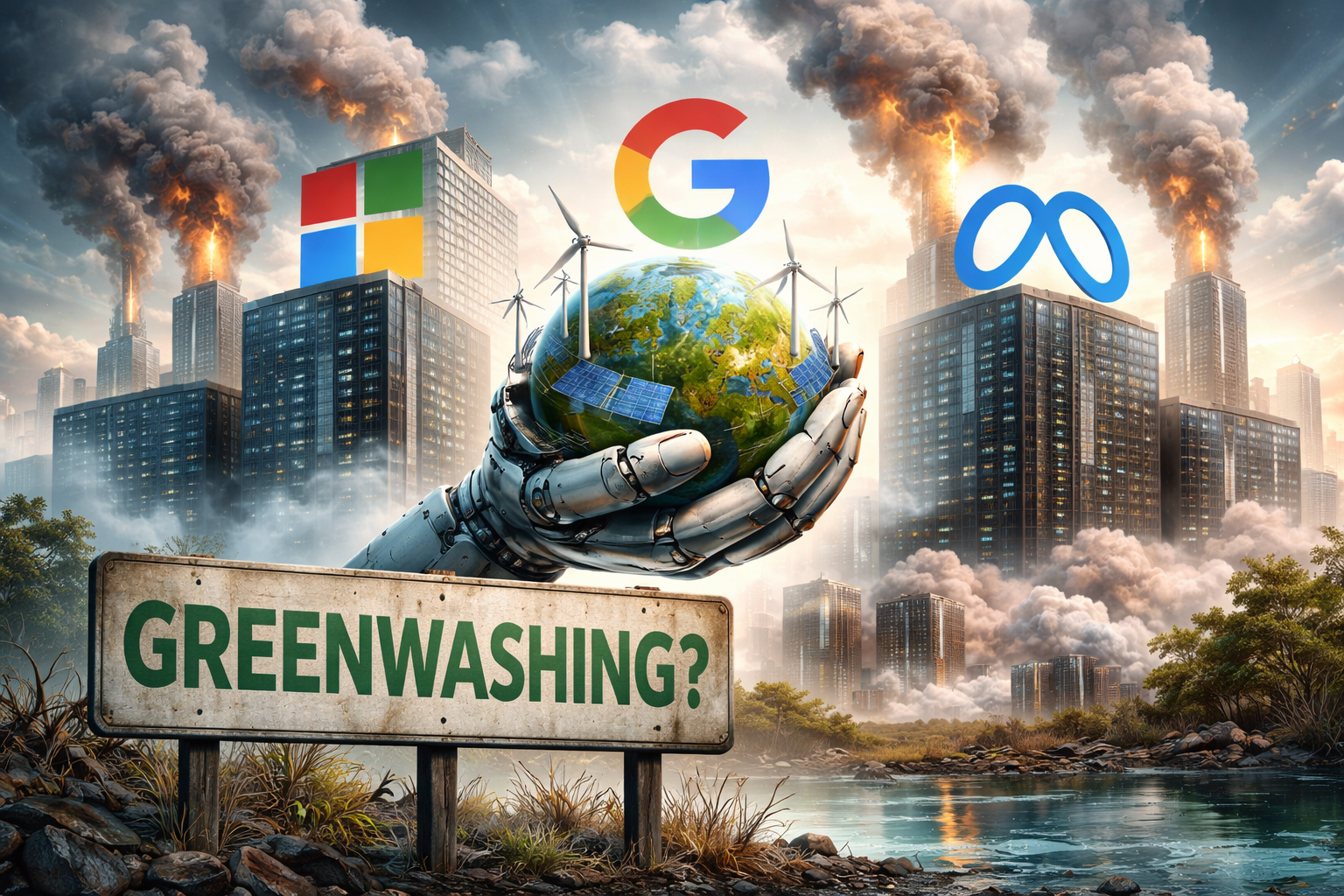
The story has had an almost magical quality to it: artificial intelligence is going to help solve the climate crisis. Tech companies talk about “smarter grids,” “clean cities,” and “carbon cuts” thanks to AI. It’s an appealing narrative, especially in an era in which AI is fueling the development of new, energy-intensive data centers.
But the promises made by Big Tech’s AI may not be based in hard science, according to a new report, which says the claims are “greenwashing”, even if they’re made with the best of intentions.
The report does not say “AI can’t help solve the climate crisis.” Instead, it says many of the claims made by tech companies are too fuzzy, too muddled, or simply too unprovable, especially if they’re made without hard data to back them up.
What the report found
Commissioned by Beyond Fossil Fuels and Climate Action Against Disinformation and written by energy analyst Ketan Joshi, the report examined 154 public claims made by tech companies about the climate benefits of AI. Its findings are stark: 74% of the claims were “unproven.”
But the bigger problem, the report says, is that tech companies are combining the benefits of traditional AI with the benefits of the newer, flashier “generative AI”, even though the two have very little in common.
Traditional AI is the quiet, behind-the-scenes AI used to predict the weather, improve industrial processes, or help power grids run more efficiently.
Generative AI is the flashy, in-your-face AI used in chatbots, image generators, or video generators.
According to the report, many tech companies have pointed to the proven benefits of traditional AI, and then used the good name to “rub off” on the unproven benefits of the newer, flashier “generative AI”, like Google’s Gemini or Microsoft’s Copilot.
The significance of the term ‘greenwashing.’
The term ‘greenwashing’ does not imply that the firm has done nothing to be green. It simply implies that what is being shown to the public is greener than what has been done.
The significance of this debate
The debate over this topic is important, as AI is emerging amid a boom in data centres. The International Energy Agency has stated that in 2024, data centres consumed 415 terawatt-hours of power. This is 1.5% of global electricity consumption. Power consumption in data centres has been rising by 12% annually since 2017. (IEA)
In America, in 2024, 4% of total electricity consumption was consumed by data centres. However, this consumption is set to increase by over two times in 2030.
It has been stated that utilities have been spending heavily to increase their infrastructure to cater to this consumption of power in data centres. The debate over this topic has significant importance since it has been stated that American Electric Power and Exelon have announced their plans to invest heavily in infrastructure due to the increase in demand caused by data centres.
Power generation is not equally clean everywhere in the world. There are places that still use coal and natural gas to produce power. The debate over this topic has significant importance since it has been stated that when power consumption increases in such places, there is an increase in emissions, too.
Can AI help the climate? Yes, but not by default
This is the bit that gets lost in the hype: some AI can actually help the climate, and it can do it when it’s treated as a tool for a specific job.
For traditional AI, the answer is yes. For example, it can help with forecasting renewable energy, detecting methane leaks, or making buildings or logistics more efficient. These projects can be measured; you can see what’s changed, what’s been saved, and what the impact on the climate is.
For generative AI, it’s much harder to make the connection to the climate. For example, it can write a chatbot to produce a sustainability report, but writing about sustainability isn’t the same as actually doing it. And it can actually make the problem worse because it makes it easy and fun to use more computer time throughout the day, even when the work isn’t important.
The transparency problem: “trust us” isn’t enough
Part of the reason the argument keeps resurfacing is that the impact of AI on the climate isn’t clear. Companies release sustainability reports, but the information independent researchers want isn’t always included, or when it is, it’s not detailed.
The report, along with other critics, is calling for clearer “labels on the box,” which means clearer reporting on generative AI energy use, local grid use (since location matters for the “climate math”), and better evidence for big claims. In other words, “if a company says ‘AI cut emissions,’ we want to see the receipts.”
From Slogans to Receipts
The report comes at an awkward time for the industry. Many tech companies are going green, investing in renewables, while at the same time, their use of AI is growing at an alarming rate. This creates an easy temptation to spin a narrative: “Don’t worry about the energy, we’ll get to that later. AI will sort it out.”
The problem, highlighted by the report, is that “later” is not a strategy. “If we’re going to use AI to help address the climate crisis, we need to understand the specific, measurable, and transparent benefits, and separate them from the costs.”
Because, let’s face it, “the planet doesn’t run on vibes. It runs on electricity.”
Click here for more trending, research-backed news articles.